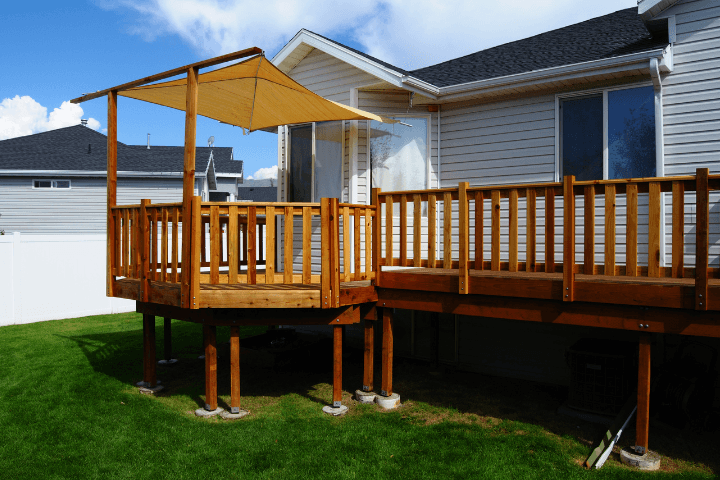
Are you planning on building a deck in your backyard, but aren’t sure which type of foundation to install? Your patience has been rewarded! Have you ever thought of piles? It’s a cost-effective, eco-friendly, and simple solution, one that’s been developed by a Quebec-based company that’s also a global market leader.
The Benefits of Foundation Piles for Your Deck
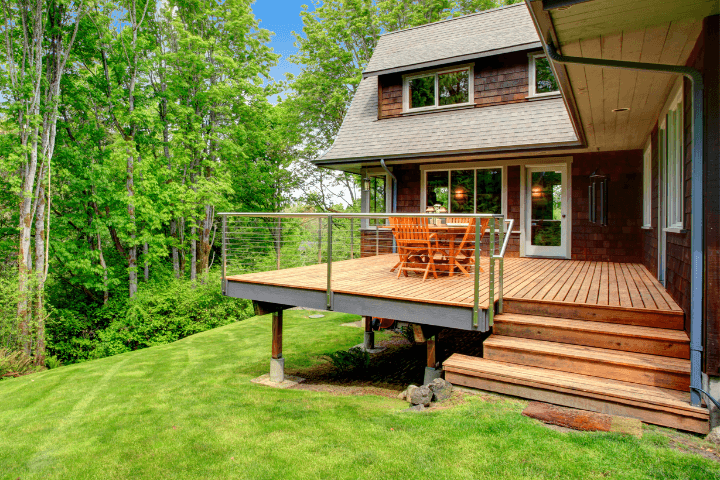
The advantages are, first and foremost, technical:
Fast installation (few minutes)
Devoid of excavation
Not weather dependent
Project adapted piles (size, amount of helical blades, etc.)
Longer lifespan
There are also environmental benefits since the piles are:
less concrete intensive;
installed with biodegradable fluids; and
recyclable.
The Different Pile Types
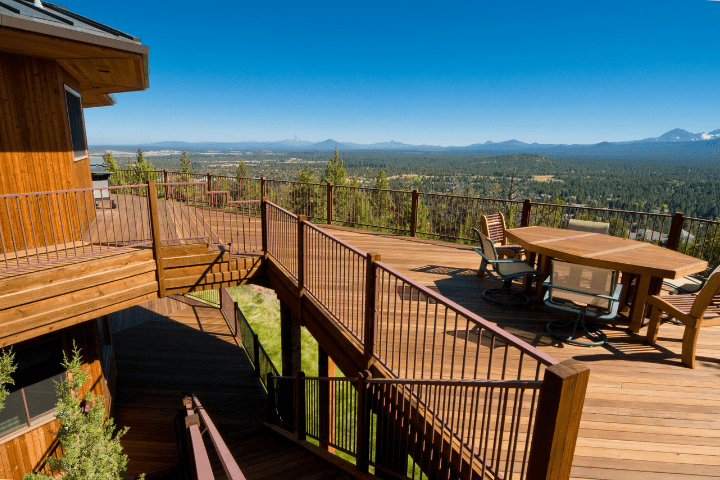
Concrete or Wooden Piles
Wooden piles have, for a while now, taken a back seat to concrete piles. At times, galvanized steel piles will prevail, and on other occasions, the front runners may be piles made from a clever mix of the two.
The superiority of concrete piles isn’t simply on account of freeze cycles that damage wooden piles, but on account of the following three reasons:
Easier manufacturing process
Greater durability
Better resilience
As such, being made to choose between wooden piles or concrete ones, one might as well opt for a top-tier product, meaning concrete.
Techno Metal Posts: Tailor-Made Innovation for Decks
Techno Metal Posts is a Quebec-based company that promises a straightforward pile installation. With over 100 employees, scattered between five production plants, their goal is to turn this pledge into a reality, day in, day out.
This global leader in screw piles allows you to build decks on solid ground. Since this technology is Quebec-based, it’s perfectly suited to the province’s unique constraints, such as:
Clay soils
Frost level
Freeze-thaw cycles
The technology used is rather straightforward: screwing helical piles as per the mandated depth.
How to Install Screw Pile Deck Footings
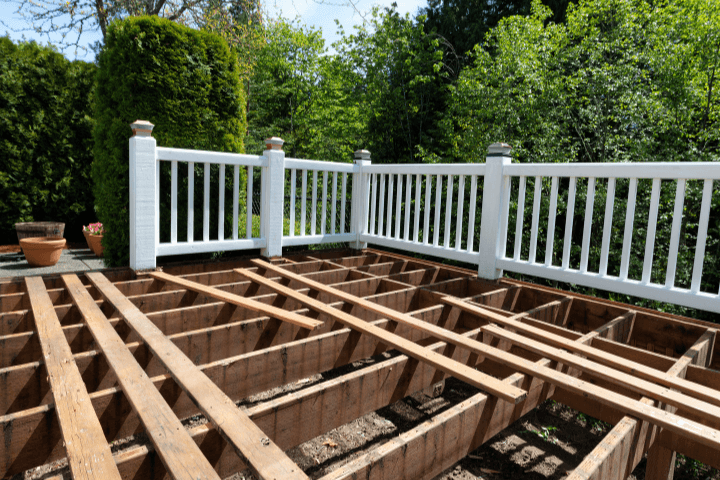
How deep should the piles be driven into the ground?
To hold up, a screw pile’s last helical blade must be surrounded, top and bottom, by soil possessing an adequate bearing capacity. In the majority of the inhabited regions in our province, the piles must pierce expansive clay soils to find stable ground.
Therefore, some construction projects require piles to be driven 12’ 6” (3.65 m) into the ground, while others solely mandate 8’ (2.40 m).
How to Calculate the Number of Piles Needed for Your Deck
It all depends on the deck in question. If the deck is anchored to the house by one of its sides, the foundation won’t have to bear the lateral load. As such, the piles may be smaller in size and number.
If the deck isn’t attached to an existing structure, the number of piles needed spikes, much like their diameter. To gauge the amount of piles to install, the deck builder will carry out an analysis, which they will then submit to Techno Metal Posts’ engineering services.
From there, the engineers will assess the number of piles needed based on the following:
Soil type
Deck size
Location (freestanding or anchored to a structural component)
Surrounding environment (height of phreatic zone, near a body of water)
However, in theory, to form a solid base, the piles must be 8 to 10 feet (2.4 to 3 m) apart.
How many piles do you need for a 16 X 16 deck?
Based on the rule above-mentioned, to ensure each and every pile is 8 feet apart, you’ll need at least 8 of them.
How many piles do you need for a 12 X 12 deck?
Still based on the rule that there must be 8 feet of spacing between each pile, you’ll need at least 6 piles to build a foundation that’s strong enough to bear the load of your deck.
How much does it cost to install screw piles?
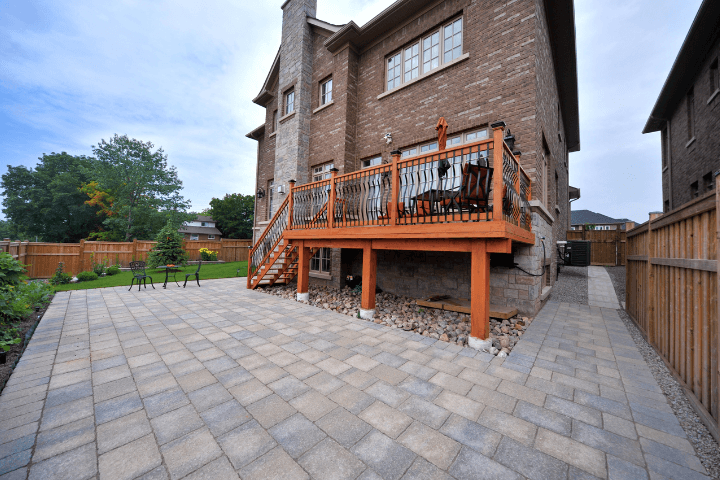
Several factors come into play when it comes to screw pile installation costs:
Pile length
Helical blade size
One or several helical blades
Quality of steel used
This choice ultimately depends on the type of soil onto which the deck will be built, as well as its size. If you’ve already perused our article about screw pile foundations, you already know that:
fine-grained soil (clay, silt) requires a more significant spacing between the helical blades; and
coarse-grained soil (gravel, sand) doesn’t mandate such a significant spacing.
Therefore, the piles' unique characteristics, as well as their overall costs, will determine the compressive strength of the foundation.
Sonotubes: An Alternative for Your Deck
A Sonotube pile is a cylindrical, cardboard-made forming tube. It's driven into a hole in the exact spot where a deck pile will be later installed. Then, concrete is poured inside to form a solid foundation.
To ensure you’re proceeding as you should, use at least 20 cm (8 in) wide tubes. That way, you can reap the following benefits:
Lightweight
Straightforward installation
Transportation-friendly
Pile-Supported Deck: The Key to a Solid Foundation
What’s for sure is that a deck on helical piles comes out as an unwavering solution, combining strength and durability, creating an outdoor living space capable of withstanding the test of time. By embracing this approach, you’re not only investing in structural stability, but also peace of mind, ensuring a robust and reliable lounge area for years to come. Opt for safety and durability with a pile-supported deck, a solution that’s redefining sturdiness in a world of outdoor living spaces.
Get 3 quotes for your renovation project
RenoQuotes.com can help you get quotes from a general contractor. By submitting your project, we’ll put you in contact with top-rated contractors. Fill in the form on the homepage (it only takes a few minutes) and get estimates from trusted professionals.
Dial 1-844 828-1588 to speak with one of our customer service representatives.
Looking for something else?
Related articles
The latest industry news, interviews, technologies, and resources.
Editorial Team
•05 Jun 2025
Unless you've been living under a rock, you've certainly seen or heard about the impressive number of home renovation reality shows featured on television, both here and abroad.
Cynthia Pigeon
•08 Nov 2023
Since summer is a short-lived experience every year in Quebec, most of us try to squeeze the most out of the season by designing outdoor spaces to fully enjoy sunny days. Building a patio is a good idea should you want to have an outdoor seating area, paired with a table, barbecue, and sunshade.
Editorial Team
•02 Mar 2026
When choosing a front door, one usually considers five essential factors: security, insulation, aesthetics, maintenance, and budget. However, there’s another factor that often takes precedence — lighting. And for that reason alone, more and more homeowners thinking of installing windows and doors Toronto and other parts of Canada are opting for glass-panelled front doors.
Cynthia Pigeon
•13 Apr 2026
In 2026, the cost to replace the roof of a standard single-family home in Canada generally ranges from $10,000 to $18,000 for asphalt shingles. For a metal roof, the budget typically falls between $25,000 and $50,000, depending on the surface area, slope, accessibility, and complexity of the project. These estimates typically cover the removal of the old roofing, debris disposal, new materials, and labour by a qualified contractor holding the appropriate provincial licences—ensuring your roof can withstand Canada’s demanding climate.
Cynthia Pigeon
•01 Aug 2026
Modernizing a lighting system involves much more than replacing a burnt-out bulb during a weekend renovation project. In Canadian homes, smart home technology has become an increasingly popular way to improve comfort, security, and energy efficiency. Centralized or automated lighting controls can turn off lights in unoccupied rooms, simulate occupancy while you are away, and create comfortable lighting scenes suited to different seasons and routines.