How To Improve The Energy Efficiency of Your Windows
By Amanda Harvey
Updated on November 8, 2023
During the warmer months of the year, letting a cool breeze in through the windows of your home feels like a treat. However, during winter time those drafts feel particularly frustrating, blurring the lines between indoors and outdoors.
If you find air escaping outdoors or into the rooms of your home, chances are your windows are not sealed properly. Not only does this sacrifice comfort, but is also a real issue when it comes to energy efficiency.
Chilly air that seeps into your home causes your heating system to work twice as hard, and warm summer air that finds its way inside makes air conditioners pump faster. You can reduce your carbon footprint while keeping your money firmly in your pocket by adopting ways to improve the energy efficiency of your windows.
Here's how to improve the energy efficiency of your windows!
Caulking and weather-stripping

source: Pixabay
A significant amount of air leaks from around windows, especially if they have not been sealed correctly. Caulking and weather-stripping are arguably one of the most cost-effective and easiest ways to improve the energy efficiency of your home by reducing leaks in your window frames and hardware. First, it is important to check if there is any missing glass or rotting wood around the frames of your windows. If you find signs of either of these, you should take the initiative to repair them, wearing the proper protective gear while doing so.
Following this, use caulk to seal any cracks around windows that are less than ¼ an inch in width. Caulk should only be used in the areas surrounding the window, such as where the trim meets the wall. Do not use caulk directly on the pane. If gaps are larger than our offered size or have an irregular shape, it is recommended that you use spray foam to fill in the space.
Weather-stripping is an alternative to caulking, though the two methods are not interchangeable. Weather-stripping should be left for the parts of windows with movement. There are several types of window weather-stripping on the market, so do your research or bring some questions to your local hardware store.
The stripping you choose should seal in any air from escaping while still allowing the window to open and close freely. Further, if either of these methods feels too permanent, there are temporary options on the market and they will be labelled as such. That way, you can seal your windows for the colder seasons and have air run freely during the warmer ones if necessary.
Drapery
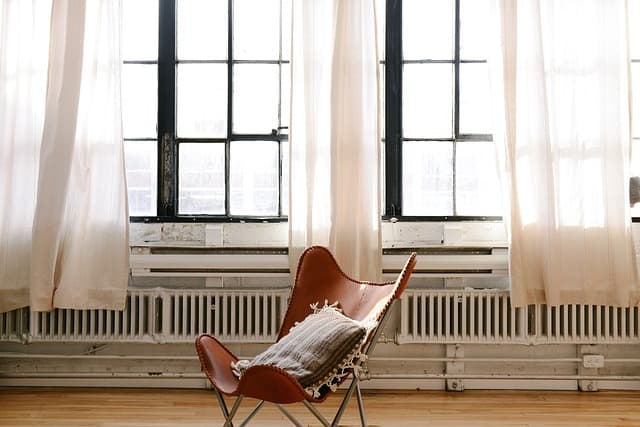
For keeping rooms warm, and thus, allowing heating systems to work at their own pace, it is important for you to consider covering windows with curtains or drapes. Though this may seem like an aesthetic choice, hanging curtains from your windows acts as an extra thermal barrier.
Hanging drapes can work to decrease discomfort during winter months as well as reduce heat from the sun during summer months, and most experts would argue that the simple task of putting up curtains reduces heat loss and gain by up to 25%.
Of course, this method will not stop air leaks, but working in tandem with caulking and weather-stripping is an excellent method to reduce your home’s carbon footprint and improve your energy efficiency.
Window Panels and Storm Windows

source: Pixabay
If your air leakage problem goes a little bit deeper then installing caulking or hanging curtains, another method to consider in order to reduce your carbon footprint and save energy is installing insulating window panels or interior storm windows.
These are similar methods of insulation, as both typically contain an insulating material that has been cast inside a wood or metal frame. This frame will seal tightly against your existing window, and this is usually by way of magnets or Velcro.
Weather sealing is not permanent, and window panels can be removed and reused per season. Bear in mind that for either window panels or storm windows to work correctly, they must be installed correctly. When well constructed and well installed, these style windows can reduce air infiltration, and lead to overall energy saving of between 10-15%.
However, depending on whether you are installing window panels or storm windows, your view may be slightly obstructed as not all the materials are transparent. Also, worth noting is that these windows can be costly upfront, but if you’re interested in reducing the amount of energy your home uses, and thus, saving in the long run, it is well worth the investment.
Double-Glazed Windows
Double-glazed windows consist of two layers of glass which are separated by a pocket of air between them. This type of window creates an extra barrier and twice the insulation of a regular single-glazed window, and this has nothing to do with the glass itself. In fact, it is the air that rests between these two pieces of glass which create the insulation.
When double-glazed windows are made, the air between the glass is dried and the space is sealed airtight, meaning that no air can escape in or out. Though these have a similar method to that of storm windows, it can be argued that double-glazed windows are more effective at reducing heat loss and keeping down energy costs.
Get 3 quotes for your window renovation project
RenoQuotes.com can help you get quotes for window project. If you submit your project to us, we’ll put you in contact with top-rated contractors. Fill in the form on the homepage (it only takes a few minutes), and you will get estimates from trusted professionals.
Dial 1-844 828-1588 to speak with one of our customer service representatives
Looking for something else?
Related articles
The latest industry news, interviews, technologies, and resources.
Editorial Team
•08 Nov 2023
Building a staircase is somewhat of an art form. In fact, a staircase is an architectural feature distinguished by its design. Whether it’s made of wrought iron, wood, concrete, or steel, it has led many skilled professionals to create real masterpieces.
Cynthia Pigeon
•15 Jun 2026
The cost of a conversion varies depending on the home’s configuration, the electrical work required, and whether the selected system includes a heat pump. In many cases, the bill is higher when major electrical work or a central heat pump is added. Although the provincial Chauffez vert program ended on March 31, 2026, combining current financial assistance programs, such as Hydro-Québec’s LogisVert grant and the federal OHPA program, can help eligible households significantly reduce their out-of-pocket costs, though a residual cost should generally still be expected. Depending on the price of heating oil, the performance of the heat pump, and the characteristics of the building, heating savings can be significant, but they vary from one property to another.

Editorial Team
•08 Nov 2023
The basement of your home shouldn’t be an afterthought. In fact, a significant amount of time and dedication should be focused on making this space comfortable and at the very least, livable. Not only will this add to the resale value of your home, but having a properly insulated basement will save costs on energy bills and keep indoor temperatures comfortable.
Editorial Team
•02 Apr 2026
Noisy pipes are likely the cause of a significant problem, often leading one to hire a plumber.

Editorial Team
•11 May 2026
We’ve said it before and we’ll say it again, curb appeal is real! Tending to and maintaining a beautiful garden on your front or back lawn brings a lot to a home.