
Among the many renovation projects out there, painting projects are most accessible to apprentices in the industry. Indeed, painting is part of our daily lives and few are those who can ever say they've never been called to lend a hand to change the appearance of one or more rooms inside a home.
However, rarely is the difference between industrial paint and the one used for residential projects ever talked about. So, here’s everything you need to know about industrial painting and its specifics.
Industrial Paint: Everything You Need to Know
Source: Canva
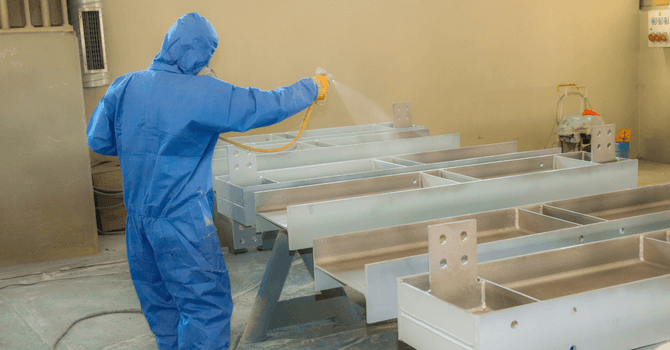
Right off the bat, you may be wondering about the relevance of using paint specifically designed for industrial spaces. Why exactly would we avoid using standard paint? Keep in mind that industrial spaces are generally exposed to very specific conditions including cooling or heating, frequent use and exposure to chemicals, which tend to accelerate surface wear.
To maintain favourable conditions to maintain the paint and its durability, it’s necessary to resort to using industrial paint and painting methods. Indeed, this type of paint must provide effective protection against physical onslaughts, both chemical and environmental, while naturally fulfilling its purpose, which is to embellish the room, aesthetically speaking.
What exactly is industrial paint?

Source: Canva
Although it often comes in liquid form, industrial paint may also come in powder or paste form. When applied according to the manufacturer's guidelines, the paint will adhere adequately to the surface and become a solid filter that protects it.
Of course, the specific type of paint purchased will depend on its intended use. Thus, it’s essential to take into account the surface on which the paint will be applied: gypsum, aluminum or wrought iron structures, machinery, cinder blocks, concrete floors, and so on.
Industrial Paint Components
As the name suggests, thinners help give the paint an appropriate consistency, which is favourable for its application. Otherwise, the paint would be much too thick to spread over a surface. Also, thinners serve the purpose of stabilizing paint inside the container. It’s important to emphasize the presence of several types of thinners: ketones, chlorides, aromatic/aliphatic hydrocarbons and alcohols.
As with residential paint, the pigments found in industrial paint obviously give it its colour, but also its opacity. It should be noted that there are several types of pigments:
Inert pigments: Usually, this type of pigment is used for undercoats and coatings. These have a low refractive index and thus have a moderate impact on the colour of the paint itself. They’re used to obtain satin or matte finishes.
Special pigments: These refer to a set of different pigments whose unique nature doesn’t allow them to be included in the other categories in this list (toxic, pearlescent, intumescent and metallic pigments).
Covering pigments: Once again, this type of pigment has a name that evokes its properties! It’s used to opaquely cover the surfaces to which it’s applied.
Anti-corrosion pigments: As their name suggests, anti-corrosion pigments prevent corrosion. This is why they’re used for paint layered directly on steel, as well as plaster.
As far as additives are concerned, their goal is to reach specific objectives that fulfill particular needs incurred by various types of projects. Among these, there’s the need for colour nuance, to generally improve the quality of the paint or to strengthen the surface to which it’s applied.
For their part, binders give the paint its ability to protect the surface by forming a film where the paint is applied after it’s dried. Binders include various categories such as polyester resins as well as polyurethane-, acrylic- and epoxy-based.
Industrial Painting Project: Steps

Source: Canva
When it comes to carrying out this project, first off, one or more coats of primer will need to be applied.
As with a residential painting project, it’ll be essential to fill any holes or imperfections in the surface before applying any paint. Also, before moving on to the next step, it’s necessary to wait until the first coat is completely dry.
Then, you’ll need to apply a coat of paint between the first (primer) and top coat (if necessary). Since it's thick, this coat eliminates the need to apply more than one topcoat. Note that this coat has fewer pigments and binders than a primer.
Once this step is done and the drying time was respected, you can apply a topcoat. This will be applied directly on the middle coat or on the primer (should a middle coat of paint have been applied). Finally, seal this project with a coat of varnish, the finish of choice can be either very glossy, glossy or even matte.
As you may already know, an industrial painting project can take on many forms. Since such paint can be applied to a variety of surfaces (concrete, wood, metal, drywall, etc), note that you have to select the right coating to complete this project. Either way, the paint needs to be as durable as it is tough.
Why use a primer?
Since it's the first coat of paint that's applied directly onto metal surfaces (cast iron, stainless steel, galvanized, etc.), it acts as a protective shield and protects the surface from oxidation thanks to its anti-corrosion pigments.
With just a little bit of binder and resin, the primer smooths the surface, which sets up the groundwork for subsequent coatings.
Looking for something else?
Related articles
The latest industry news, interviews, technologies, and resources.

Editorial Team
•03 Jun 2025
Underpinning is a technique that is essential to ensure the stability of a building whose solidity is compromised due to a natural disaster, upper floor renovations with excessive added weight to support, or due to a foundation being poorly adapted to the ground where it is set.

Editorial Team
•16 Nov 2023
The bedroom, a peaceful, rest and relaxation haven, is, for all intents and purposes, an area that’s particularly cherished. And, the feature that obviously conjures relaxation the most is, without a doubt the bed, which one slumps onto after a workday.

Editorial Team
•08 Nov 2023
Buying a house is probably the single most important financial investment of a lifetime. Therefore, a future homeowner should be assured of paying a fair price for their new property and avoid being confronted with unforeseen work and the costs that come with it.

Editorial Team
•08 Nov 2023
The garage isn't a space just for cars anymore. With homeowners becoming more creative with their personal space, the garage is often used as an alternative workspace, gym or haven from the rest of the house.

Christine Simard
•08 Nov 2023
When scrolling Pinterest or Instagram, it’s easy to quickly notice changes in interior design trends. Usually, your feed is curated according to what you enjoy looking at but sure enough, one stray post can catch your attention and soon send you down the rabbit hole of new decor styles and trends for the year.