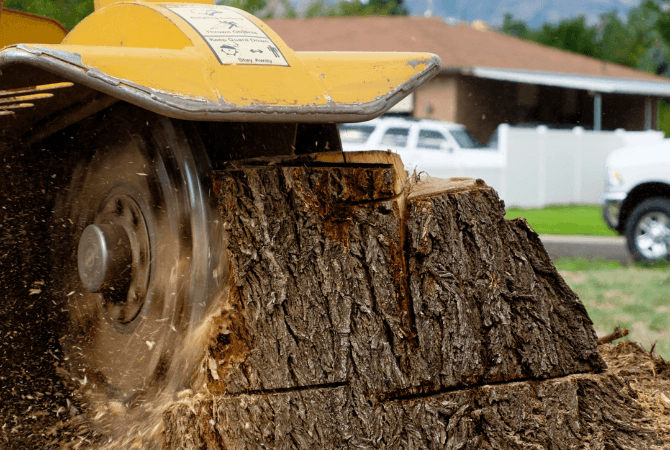
Are you looking to increase the space available in your yard, or simply for health and safety reasons, need to remove a tree? Note that once said tree is cut down, its stump will remain rooted, and you should really consider having it removed.
There are plenty of solutions available. To no great surprise, following alternative methods found on the Internet is probably not the best way to go. In fact, burning the stump or filling it with chemical products like sodium chlorate or bleach is highly advised against. Proceeding as such would increase the risks of contaminating the soil, in which the stump is rooted, or allowing slow decomposition by way of insects.
That’s why cutting down trees and grubbing are part of the many services offered by certified tree pruners or qualified arborists.
What’s grubbing?
Removing tree stumps, also known as grubbing, as its name clearly states, entails removing a tree’s stump, meaning the leftover portion of the trunk that’s deeply rooted beneath the ground. Done mechanically and according to the guidelines, this task won’t damage your yard. Quite the opposite actually, you’ll even be able to plant another tree or use the chips as fertilizer or mulch.
Why remove a tree stump?
Source: Canva
Besides the two more obvious reasons, whether for aesthetic purposes or to avoid tree regrowth, several factors account for grubbing:
To prevent the ground surrounding the area from sinking in: The roots will end up decomposing resulting in a hollow area beneath the ground surface.
To avoid attracting insects, rodents/animals, and fungi: A stump is a source of food (mushrooms, mould, etc.) and is a marker for some insects, notably carpenter ants. And nobody wants those in close proximity to their home.
Moreover, where there are insects, there are animals to snack on them, like skunks, raccoons, and so on. Also, if you want to spare your garden and trash, best not to attract them.
To keep away any dangers and problems: Obviously, someone could trip over the bit of leftover trunk sticking out from the ground or injure themselves if the area around the stump is sinking in. Also, the roots could clog your pipes or plague nearby plants.
When should you remove a tree stump?
Source: Daniel Farrell – Flickr
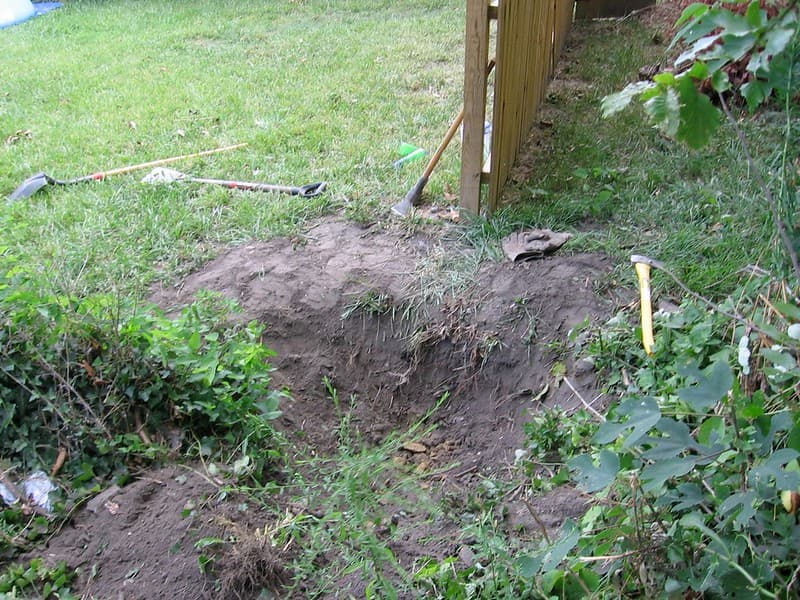
The best time of year to have tree stumps removed is the summer. The idea behind it is to avoid snow build-up or heavy rainfall since the soft ground can pose a problem. Actually, in such conditions, any required machinery would have difficulty reaching the work area or could seriously damage the property by sinking into the ground.
Likewise, if the ground is frozen, removing the stump risks getting more complex or nearing impossibility. Lastly, if dealing with poplar species or a Manitoba maple, it’s best to proceed the same day the tree is cut.
The Best Way to Remove a Tree Stump
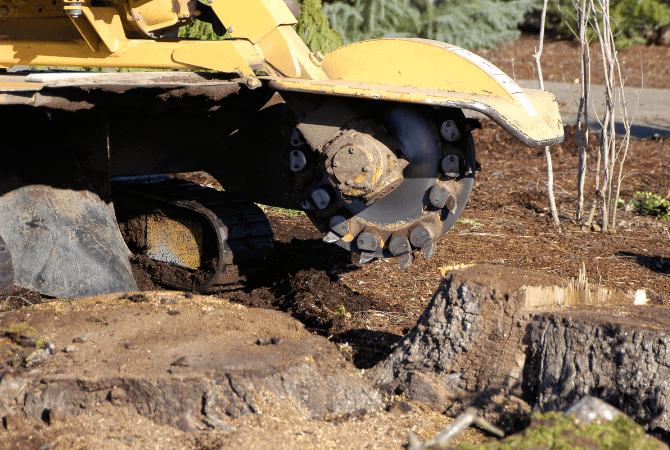
Stump grinding has long been recognized as the most cost-effective, eco-friendly, and non-destructive method of removing tree stumps on your property. Besides being tailored to urban environments, this technique preserves microorganisms near the roots.
The stump grinding process consists of crushing the stump with a wood chipper rather than digging it up with a backhoe. The wood chips obtained from this process can be used to backfill the area. However, since only using said chips to fill in the cavity left from the stump removal isn’t recommended, you’ll need to mix in some dirt, without which the soil would become acidic or unstable.
As mentioned at the beginning of this article, wood chips make for excellent fertilizer and can be used as mulch to surround shrubs as part of your landscaping. Nonetheless, if you still don’t want them, the labourers will be able to dispose of the wood chips in an eco-friendly way.
Good practice dictates that for every tree removed, another should be planted within 6 months, either in the same spot or elsewhere. Note that planting native trees is strongly advised against.
How much does it cost to remove a tree stump?
The service cost is based on numerous factors, such as the size of the stump and if it can be easily accessed. The bigger the tree trunk, the longer it’ll take. To nearer it is to a roadway, the harder the removal process will be. As such, costs will vary between $100 and $1,000 per stump.
Tree Assessment & Cutting
Source: Sue Thompson – Flickr
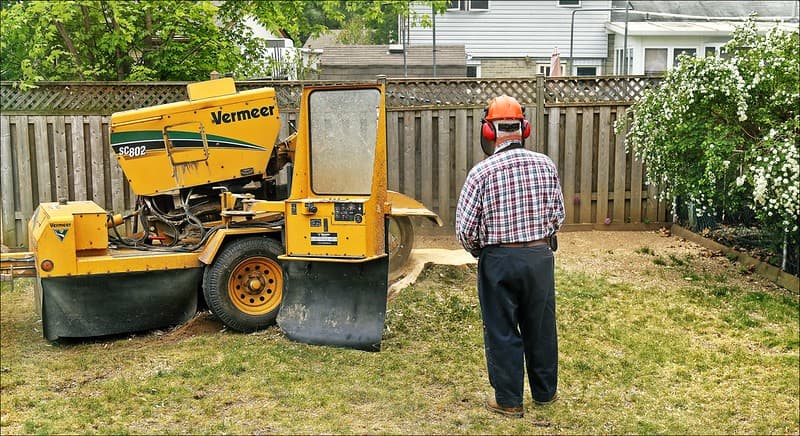
The first step entails booking an appointment with a professional to assess your needs. Sometimes, a sick tree isn’t for all intents and purposes, doomed. Maybe you can save it instead of cutting it down.
If the state of the tree can’t be remedied or you still wish to dispose of this tree, make sure that there are no cables or pipes hindering the pruning, and subsequent cutting and grubbing process.
Prior to agreeing to the costs and dates established by an arborist service, you have to get a fell tree permit for all trunks exceeding 5 centimetres in diameter. Note that ash trees are part of another subgroup, and also part of different subsidies and regulations.
A professional’s assessment is all the more necessary to secure this permit since you'll only be allowed to cut down the tree if:
It’s dead or has a deadly illness and/or is a danger to flora and fauna;
It’s damaging your property or compromising the building of a new structure (pool, driveway, garage, etc.);
It’s a safety risk.
Once these preliminary factors are established, you can go forth with your tree-cutting project. Soon will be time to remove the stump.
Cover image: Twentyfour Students – Flickr
Get 3 quotes for your tree stump removal project
RenoQuotes.com can help you get quotes for your landscaping project. If you submit your project to us, we’ll put you in contact with top-rated contractors. Fill in the form on the homepage (it only takes a few minutes), and you will receive quotes from companies that are specialized in home renovations.
Dial 1-844 828-1588 to speak with one of our customer service representatives.
Looking for something else?
Related articles
The latest industry news, interviews, technologies, and resources.
Editorial Team
•18 Apr 2024
Have you noticed the presence of traces of humidity in your crawl space? You're right to wince because a buildup of moisture is never good news.
Editorial Team
•08 Nov 2023
If you’re ready to try your hand at landscaping and creating your own garden, then you’re probably feeling pretty excited about picking out plants and flowers. In your search for the most beautiful options for your lawn, you’ve likely come acros the terms “annual” and “perennial”.
Cynthia Pigeon
•09 Sep 2026
In Quebec, basement water infiltration is the most common type of residential insurance claim. According to the Insurance Bureau of Canada, water damage accounted for 68% of home insurance claims paid in Quebec in 2024. Harsh winters, major spring thaws, and heavy summer rainfall place considerable hydrostatic pressure on the below-grade portions of our homes.

Editorial Team
•06 Dec 2025
Pretty much all renovation projects consume a significant amount of time, money and patience. Of course, the reason most homeowners take on a renovation is to improve their quality of life as well as their home resale value.

Karine Dutemple
•05 Nov 2024
Are you tired of the boring décor in your bedroom? Do you want to transform your space into a grand relaxation area? How can you infuse elegance into your room while ensuring it remains comfortable and inviting? What about balancing contrasts or adding a touch of romance? If you’re looking for inspiration, you’ve come to the right place! Explore these ten stunning examples of elegant bedrooms that will inspire you to refresh your décor and create the serene retreat you’ve always wanted.