How to Apply Drywall Joint Compound
By Léa Plourde-Archer
Updated on July 25, 2024

Applying drywall joint compound is an art that requires patience and meticulousness. Contrary to other types of renovation projects, this task is accessible to anyone. However, in order to ensure good results, it is important to follow certain guidelines.
The job will last at least 4 days, as three separate coats of drywall compound will have to be applied, with an 18 to 24 hour waiting period between each coat. If you are inexperienced, you will have to work more slowly to apply the product in the right way.
Preparation before applying the drywall compound
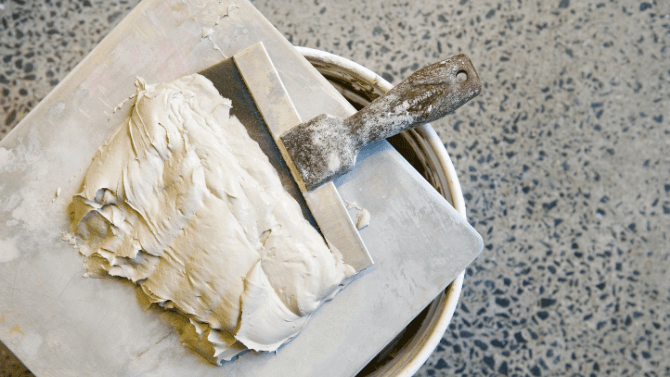
Source: Canva
Start by emptying the room where you will be working and protecting the surfaces that cannot be removed. It is also recommended that you cover the furniture in rooms nearby, as the dust has a way of spreading around.
If necessary, install metal corner beads, which will serve to unite gypsum panels that meet at the exterior corner of two wall sections (see the photo below). Be careful not to nail or screw them in too tightly, as this could cause them to warp.
Necessary equipment for drywall compound
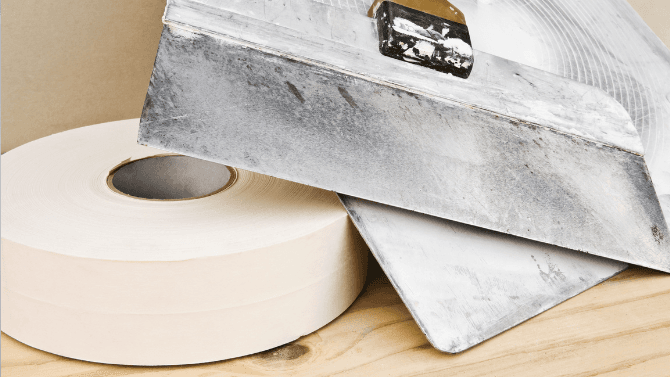
Spatula;
Two trowels (different sizes);
Drywall tape;
Platter or any flat-surfaced object (to mix the drywall compound);
Drywall compound;
Sandpaper;
Sanding block and sponge;
Personal protection equipment (mask, gloves);
Washcloths;
Container filled with tepid water.
Steps to Apply Drywall Joint Compound
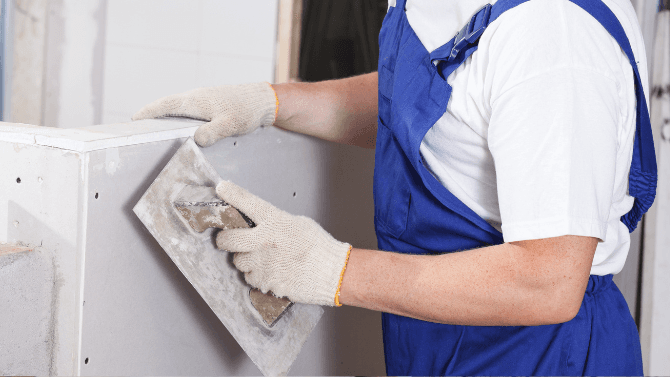
Source: Canva
The first coat of drywall
Put a little bit of the drywall compound on your platter. Next, using your trowel (the smaller one), take a bit of the drywall compound. Starting from the middle part of the joint, spread the product over the whole gap. Once you have covered the complete section, install some drywall tape.
Stretch the paper as much as possible and spread a small coat of drywall compound on top, whilst carefully pressing on the paper to create a nice homogenous surface. As you complete this part of the process, be sure to remove any extra compound that has gathered on the sides. Repeat this operation until you have covered each one of the joints. Once you have finished applying the first coat, inspect the whole area and remove any excess compound.
Photo: Flickr- Georgia National Guard
Second and third coats
Before you start working on the second coat, sand the joints very carefully, making sure not to perforate the drywall tape. For the upcoming steps, we recommend that you use a larger trowel that will serve to eliminate marks and delineations. Apply thin coats and don’t forget to clean your tools after each use.
* Notes: If the drywall joint compound is too dense, you can dilute it using a small quantity of tepid water. Be careful with air bubbles that tend to form behind the tape. If bubbles appear, the joint will have to be redone.
Sanding the surfaces
Once the last coat has had the time to dry, it’s time to work on giving these joints a nice finish. Using your sanding tools, try to even out the surfaces in order to get a nice, smooth result.
Cleaning after applying the drywall compound
After you’ve finished sanding the joints, you’ll be left with plenty of dust throughout the room. Before you start vacuuming, start the cleaning process by removing most of the dust with a broom and a wet cloth. Since the dust particles are extremely small, they may end up clogging your vacuum cleaner so it’s best to use it as little as possible. Once you’re done cleaning, you’ll be ready to start painting!
Special cases
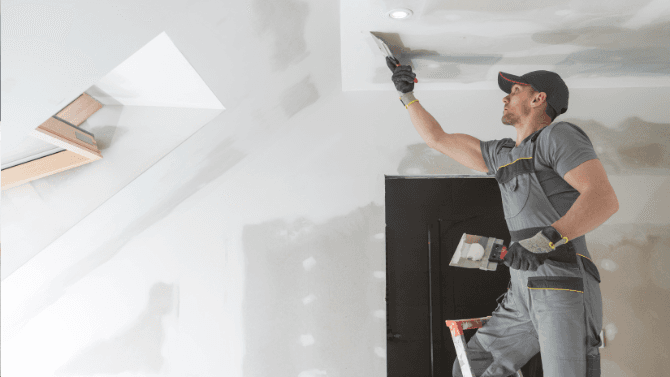
Source: Canva
The previous instructions mostly applied to “standard” joints. However, interior wall corners don’t exactly work the same way. You’ll have to be very careful in trying to avoid drywall compound accumulation in these corners. Spread the joint compound on both sides of the corner.
Next, fold the drywall tape in two and install it in the corner, starting from the top. Press firmly, using your trowel and make sure that both sides are even. For the next two coats, follow the same instructions as written in the paragraph above. In places where there are screws, insert a bit of drywall compound directly into the holes. Press strongly to even out the product.
Get 3 renovation quotes for a drywall plastering project
RenoQuotes.com will put you in contact with 3 reliable contractors for your drywall plastering project. Fill in the form on our homepage (it only takes a few minutes), and you will receive quotes from trusted professionals.
Dial 1-844 828-1588 to speak with one of our customer service representatives
Looking for something else?
Related articles
The latest industry news, interviews, technologies, and resources.

Karine Dutemple
•08 Nov 2023
In the early stages of a renovation project, there are several options to consider before making your final decisions, including comparing each option before starting anything. Materials, contractors and prizes are all examples of the different choices that will be presented to you during your research.
Editorial Team
•09 Sep 2024
Nowadays, in our homes, one of the rooms in which we spend the most time is the kitchen. Not only is it where we cook, but it’s the ideal place to spend time with friends and family, usually over a good meal. Hence, there’s value in making it cozy and welcoming. So, without further delay, why not give your kitchen the makeover it deserves to make it as homely as possible? This space can be revamped with the help of just a few clever ideas! Here are some interior décor tips that’ll make your dated kitchen look modern in no time!
Editorial Team
•25 Sep 2024
Ceramic tile flooring has a slew of advantages. Not only is it a resilient and long-lasting material, but it also requires minimal maintenance and is likely to increase the value of your home.
Karine Dutemple
•05 Nov 2024
Are you tired of the boring décor in your bedroom? Do you want to transform your space into a grand relaxation area? How can you infuse elegance into your room while ensuring it remains comfortable and inviting? What about balancing contrasts or adding a touch of romance? If you’re looking for inspiration, you’ve come to the right place! Explore these ten stunning examples of elegant bedrooms that will inspire you to refresh your décor and create the serene retreat you’ve always wanted.

Cynthia Pigeon
•14 Nov 2024
It seems like cold weather is always around the corner, so there is literally no need to highlight the importance of avoiding cold drafts wafting through your house. Since it causes both discomfort and significant increases in your heating bill, avoid this issue at all costs! Check out these helpful tips and tricks.