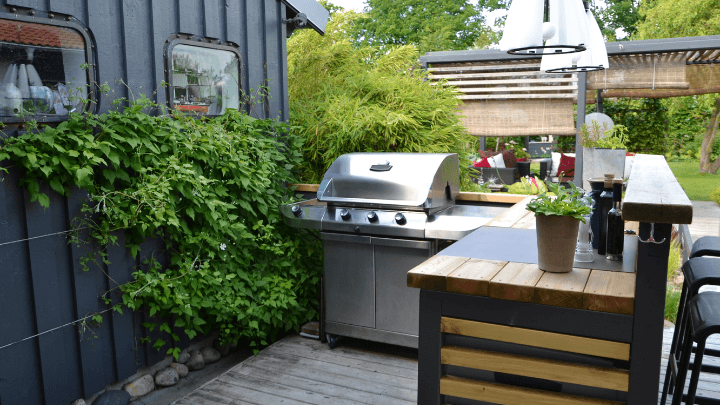
Are you dreaming of sun-filled summer days? What better than a jaw-dropping outdoor kitchen to make the most of it? But first, how does one go about getting such a large-scale project off the ground? Well, the answer couldn’t be simpler: by following a few paramount tips!
6 Tips to Consider When Designing an Outdoor Kitchen
1. Assess your needs to design the perfect BBQ corner
While it may be tempting to design your outdoor kitchen in a big and fabulous way, allowing your imagination to run free, you still have to exercise some self-control and take the time needed to really assess your needs. Unless you have an unlimited budget, it may be especially difficult to go about it any differently. To help guide you along this pondering session, start by discerning why you want such an outdoor setting and ask yourself the following questions:
How often do I cook outside?
How much free space do I have to build a summer kitchen?
Will I need specific equipment, such as a smoker or pizza oven?
What outdoor kitchen aesthetic do I like (rustic, classic, modern)?
What are my needs in terms of lighting and storage?
The information gathered when answering these questions will first serve you in determining what kind of equipment you should get, their size, and style. If the space available is rather restricted, consider purchasing smaller equipment or letting go of non-essentials.
Next, if you’re hoping to design an outdoor kitchen suited to a lot of different activities, bear in mind that you will most likely need to plan for a relatively sleek design, featuring a lot of seating, such as benches and chairs, while having enough space for your guests to move around with ease.
In terms of style, let’s just say that a lack of vision might lead to a somewhat disappointing outcome, as having any sort of inconsistency between all elements featured will be all too apparent. As for designing a kitchen that meets your needs, not unlike an indoor kitchen, take some time to think about the small things that might make all the difference: a built-in wine fridge, a bar with draft beer dispensers, or space heaters.
2. Hire a landscaper
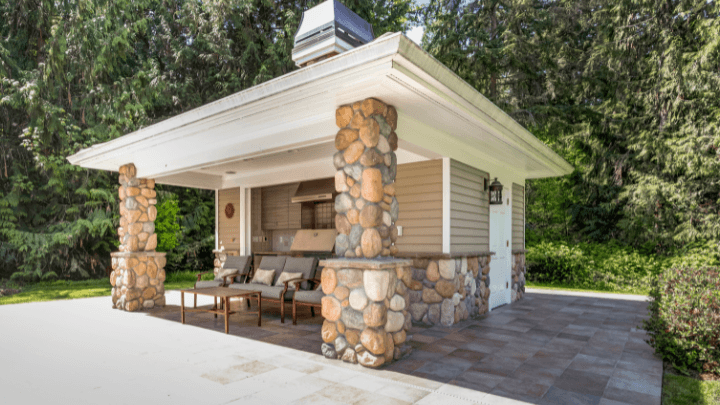
Source: Canva
If you already have an idea as to what you’d like to do for your project, you still have to consider where it will be featured, meaning your backyard. To have a clear idea of what constraints you might be facing, as well as your layout options, retaining the services of a landscaping company is a must.
A professional landscaper will advise you to plant certain types of trees to create shade, or instead, clear the area to allow natural light to shine brighter and prevent an overly bushy tree from shading the area above your outdoor kitchen.
Also, a landscaping specialist will be able to spot water channels on your property and implement strategies to prevent the latter from turning into water build-ups around your outdoor kitchen or anywhere near it. Nearby water channels may be highly problematic, especially if water comes dangerously close to electric devices.
3. Choose your patio furniture and countertop materials wisely
Any resident of Canada would tell you that the climate here is humid, and that’s the least that can be said about it. To ensure your BBQ corner stands the test of time, note that using durable materials is recommended. Among these, one can list the following:
Slate
Stone
Teak
Treated wood
Granite
Neolith stone
Stainless steel
Dekton
Naturally, the materials selected during your project must align with your budget, but also give justice to your chosen aesthetic. For those who are lucky enough to afford it, granite is a great material in terms of resistance and lifespan; it makes for an unparalleled choice.
Along the same lines, let it be said that full-bodied porcelain has a resistance worth mentioning, making it a worthwhile option to consider, much like Dekton, which is known to be tough.
4. Respect safety measures and standards
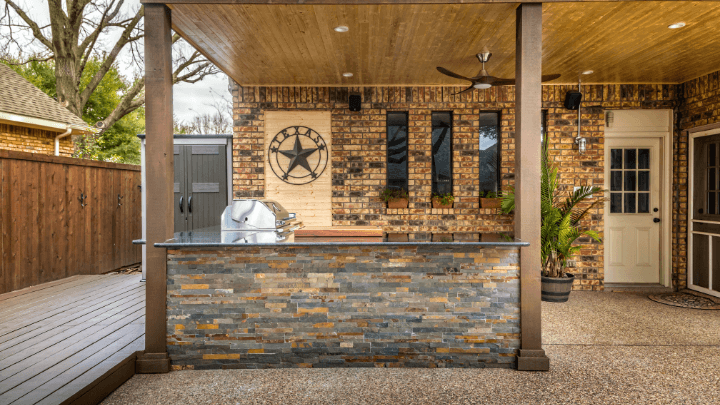
Source: Canva
If you have a decently-sized space intended for your outdoor kitchen, note that looking into the standards by which to comply regarding the distance between a burner and a BBQ is worth looking into, ensuring they’re positioned far enough from any nearby fire-hazardous zones.
Subsequently, take note of the fact that you will need a clearance on either side of your barbecue as well as behind the device. Typically, we recommend allowing for a dozen or so inches behind and 15 inches on either side. Another worthy mention: No barbecue should be installed in an enclosed area, partially covered or not, without being hooked up to a range hood for proper smoke exhaustion.
As far as any electrical connections are concerned, make sure the latter is shielded from all water sources, moisture included. As a precautionary measure, keep a first aid kit and a fire extinguisher nearby. As an additional safety measure, choose certain appliances carefully, focusing on your ability to install them outside. Feel free to inquire with professionals on the matter to make sure you’re purchasing the right equipment.
5. Protect your kitchen with a shelter
To avoid damaging the new equipment in your outdoor kitchen, cover it with a plastic tarp during off-seasons or when not in use. Even during the summer, we highly recommend planning on installing a roof or a canopy-like structure to protect your kitchen. Should you opt for the latter, plan for a semi-open structure. Otherwise, you risk shielding your outdoor setting from the sun. Should you prefer to install a full-roofed structure, allow for at least three open sides, at the risk of creating a space that's deemed too enclosed.
6. Where to install a summer kitchen? Next to a water line and power source
As you’ve probably guessed already, setting up an outdoor kitchen far from either a water line or power source will mean having to carry out water line-related work or electrical connections. In such a case, you will have to reassess your budget or compromise here and there to stick to your pre-established price point.
Looking for something else?
Related articles
The latest industry news, interviews, technologies, and resources.

Editorial Team
•08 Nov 2023
A renovation project without delays is like thunder without lightning; when one occurs, the other follows. Yes, the truth of the matter is that almost every single renovation project will experience a small or large bump in the road.
Editorial Team
•17 Feb 2025
Are you planning on undertaking a kitchen renovation project? Are you looking for information about building a kitchen in your new house? A custom-designed kitchen might just be your best option, especially if you’re dreaming of a functional, aesthetic and personalized space.
Editorial Team
•08 Nov 2023
The idea of renovating your house can sometimes spring up at an unexpected moment. Next thing you know, you find yourself browsing the internet looking for inspiration on Pinterest. However, if you're renting your apartment, it could be difficult to start any renovation projects. The final decision will be up to your landlord if you need to make any major changes to your space.
Editorial Team
•08 Nov 2023
In the middle of winter or even the early days of spring, who doesn't enjoy a long, hot shower to warm up before heading out the door? Even though a hot shower feels great, unfortunately, your bathroom doesn't share the sentiment.

Amanda Harvey
•08 Nov 2023
Running a business has its advantages and disadvantages. Regardless if you own an office, a storefront or a restaurant, there are plenty of aspects to take care of and consider when it comes to looking after a commercial space. Maybe the structure needs updating or repair or the building's plumbing or electricity is outdated. Therefore, you could be contemplating taking on a renovation. However, there are specific laws that designate what can and can’t be done to commercial properties, and this generally includes a permit application.