Several construction trades offer great professional prospects, whether for workers who wish to reorient themselves and change course or for those who wish to improve their skills. Here’s an overview of some of these promising professions!
Prospects and Opportunities: 3 Promising Occupations in the Trades
BIM Coordinator

Source: Canva
BIM is an acronym for Building Information Modeling. The main tasks related to the coordination of digital BIM models consist of setting them up, coordinating the use of a collaborative platform, and optimizing the model work processes.
By using and coordinating a common work environment for all professionals involved in the project, the BIM coordinator facilitates communication and the completion of complex projects. 3D plans also make it possible to visualize different elements of a project on the same plan, whether it’s the structure, the mechanics, the electricity of the building or the plumbing. Each specialized contractor can better design the stages of the project where they’ll enter into collaboration with each other.
Training for a digital BIM coordinator is generally done in a CEGEP, with this program offered in the form of an Attestation of Collegial Studies (AEC) lasting 405 hours. The prerequisites vary from one CEGEP to another, but require a completed a high school diploma and relevant experience in the field of construction.
Then, you’ll be able to work for engineering firms, urban planners, or construction contractors. This program was created in 2018, a sign of a need to be fulfilled over the next few years!
If you’re an engineer or architect by training, it’s also possible to follow more advanced training in the field through the specialized higher education diploma (DESS) in BIM and Digital Innovations.
Clients are increasingly providing 3D modelled plans to make life easier for contractors who can visualize the project in 3D to properly assess its feasibility.
Home Automation Specialist

Source: Canva
A person specializing in home automation is able to install and maintain smart home systems that automatically manage different parameters of a space such as security, comfort, entertainment or energy-saving efforts. Home automation focuses on the residential aspect of automation, often providing the ability to control all of these options from a single device, be it from a smartphone or tablet.
As part of this job, you’ll learn how certain security devices work, such as detectors for breaking glass, video cameras, doorbells, as well as door and window sensors. You can also install multi-room sound systems or automate other home functions such as a vacuum cleaner or motorized blinds!
Home automation is one of the components of so-called smart living spaces: you can also decide to specialize in building automation, which focuses on the automation of large buildings and institutions. You’ll work to make some processes automatic, but on a larger scale: home automation gives control of one or more rooms, while building automation may require uniform control over multiple floors!
Whether you want to work in the residential, commercial or institutional field, you’ll certainly find work in this field as it will continue to prove itself over the next few years.
A training certificate (AF) in the installation and maintenance of smart home systems of 1020 hours must be completed before and requires at least a successful Secondary 4 in the language of instruction, second language and mathematics. You’ll need to obtain authorization from an Emploi-Québec employment assistance officer before you’re able to register for this training.
To find out what home automation can mean more specifically, refer to our article: Home automation in 2022: the CHIP initiative (Connected Home over IP).
Drone Pilot
Source: Canva
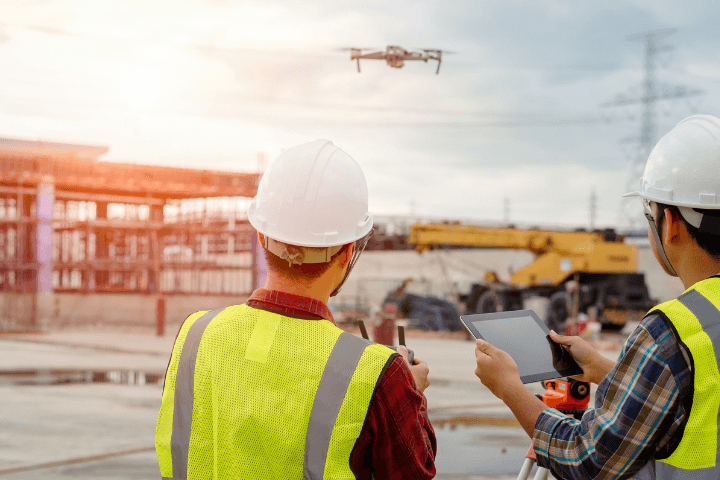
Drones are currently used mainly recreationally, but they’re starting to appear on construction sites. A drone is often equipped with technologies such as a thermal or infrared camera in order to be able to detect or take pictures of different elements of a building using these cameras or aerial photographs, among others.
They facilitate the work of many areas of construction such as surveying, agriculture, or in situations where observation can be dangerous, such as in mining projects. They can even be used to do what is called photogrammetry, which is like the reverse of photography. The process consists of recreating a 3D image from 2D photos!
As a drone pilot, you’ll have to understand, inspect, and properly maintain your equipment. Above all, you’ll need to ensure that the batteries of the drone are charged to avoid an unfortunate accident. Further, you secure the flight perimeter, in addition to planning a route.
Advancements in drone technology, such as Real-Time Kinematic (RTK) technology and LiDAR scanners, enhance the accuracy of ground surveys, allowing for precise data collection even through vegetation. The integration of these technologies with Building Information Modelling (BIM) and Virtual Design and Construction (VDC) software can significantly improve the value of drone data. For instance, drones with omni-directional obstacle avoidance and emergency parachutes are becoming safer, making them suitable for close-range data collection on construction sites.
The images that drones collect can be used later in BIM modelling. These future professions are linked, as construction in the digital age creates many jobs adapted to the strengths and preferences of each. The demand for drone surveys has increased tenfold in recent years, expanding their use throughout the construction cycle, from pre-construction mapping to post-construction showcases.
Many training programs exist depending on the type of drone and the manufacturer - find out which training leads to what you want to accomplish in this field!
In summary
As you’ll come to understand, the new construction trades, as in many sectors, are based on the automation and robotization of the most complex or dangerous tasks of our daily lives. But these tasks still require human beings to operate them properly!
With this collaboration in mind, the technological revolution in construction has the potential to reduce costs and bring interesting productivity gains. If you’re looking for a new challenge, you can certainly stay on the lookout for in-demand trades that, over the next few years, will help to carry out safe construction sites and state-of-the-art construction.
What Trade Is Most in Demand in 2024?
According to data from Statistics Canada, electrical engineers rank third among the top 10 most in-demand jobs in Canada, followed by welders in fifth place, and industrial electricians in eighth.
Why Are Construction Workers in Such High Demand?
The biggest factor contributing to skilled labour being in such high demand is Canada's aging workforce. Simply, there are more workers retiring than there are joining the trades.
Want to learn more about the future of the construction industry? Then check out our articles:
Looking for something else?
Related articles
The latest industry news, interviews, technologies, and resources.
Editorial Team
•19 May 2026
Carpentry is a cornerstone trade in Ontario’s construction industry, offering diverse career opportunities across residential, commercial, and industrial sectors. Carpenters play an essential role in constructing, renovating, and maintaining structures, making this a rewarding and in-demand career path. This article provides a detailed guide on how to become a carpenter in Ontario, covering educational pathways, certification requirements, and the vibrant job market.

Editorial Team
•03 Jun 2024
If you’re looking for a career in the construction industry where teamwork is essential and perfectionism is—at long last—valued, consider becoming a resilient interior flooring layer. This little-known profession, although essential, is seeing a significant labour shortage as a result of a large number of workers retiring.

Équipe éditoriale
•08 Jun 2026
The Canadian construction industry is facing an acute shortage of skilled labour, which is expected to worsen in the coming years. This shortage is primarily driven by an aging workforce, with a significant number of workers nearing retirement age, and a lack of younger workers entering the industry.

Editorial Team
•19 Apr 2024
An air conditioner is an important unit in any home, keeping things cool and comfortable throughout those warm summer months. However, if your AC unit happens to break, it’s likely you’ll take serious notice.

Christine Simard
•08 Nov 2023
When we talk about retro, the subject can be vast. The term mainly represents modern trends influenced from past eras, whether it be in fashion, interior design, graphic design, etc.