How to Insulate a Crawl Space : Tips and Guidelines
By Léa Plourde-Archer
Updated on May 24, 2024
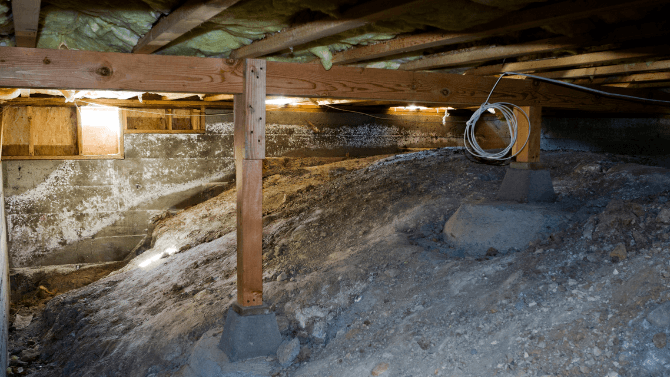
Crawl spaces are not that well known in the modern home as more often than not, they are found in older houses. However, in recent years, they have made a comeback in newer constructions and homes appearing on the market.
This is because these underground spaces can be exceptionally useful when it comes to storing seasonal items, sports equipment, furniture and so forth. However, it’s crucial that these spaces be well-insulated, well-ventilated and completely waterproof.
If your home has a crawlspace but your energy costs have risen or you’re noticing drafts in certain areas, it could come back to the insulation from this space. RenoQuotes.com has collected a few guidelines on how to insulate a crawl space
Why you should insulate the crawlspace under your house
Source: Canva
A crawl space that is poorly insulated will not go unnoticed. This is because you’ll start to see various internal issues around your home. Look out for any signs of these significant problems: frozen plumbing, humidity, mould and mildew growth, flooding, heat loss and so forth.
Not only do these problems affect the safety of your home as well as the well-being of your friends and loved ones, but they can also lead to an increase in heating bills. Due to the placement of crawl spaces, insulation problems often stem from the fact that stone and concrete walls are very bad at retaining heat.
Therefore, in order for a crawl space to be properly insulated, there need to be other materials present to fill out the role of the insulating layer. Now, we’re going to go over some of the materials and techniques you can adopt in order to insulate this space correctly.
Starting your crawl space insulation
Before you start redoing or adding insulation material to your crawlspace, there are a few things you’ll need to take care of. First, if there have been any elements that were affected by water and/or by mould, these will need to be immediately removed. Mould and mildew growth in the home is a serious health hazard, as these can lead to breathing problems and affect the lungs.
Make sure all traces of decay are carefully removed using proper protective wear including gloves and a mask. Mould spores move through the air and thus, it is crucial to protect your airways.
Once everything has been carefully removed, finish by applying an antifungal treatment, which should be left to stand for a certain period of time. Depending on the product you choose, follow the instructions according to packaging.
Also depending on the climate of your region, another step we’d suggest taking is wrapping automatic heating electric tape around your pipes. This product can easily be found at local hardware stores.
Even when a crawl space is heated, pipes and drains can freeze if they’re not being used during the winter. Since you’re already renovating this space, now would be the time to implement the solution for this problem.
The crawlspace insulation process
How to insulate your basement's exterior foundational walls and flooring
When it comes to the insulation process, there are two main techniques you can use. First, we would recommend insulating from the ground up, and working as though this space were an extension of your basement.
This means that the insulating layer will be installed on the outside walls which will allow for the crawl space to be turned into a fully heated space, as with the rest of your home.
What is the best insulation option for a crawl space?
Mineral wool is not a recommended insulation material for crawl spaces. Instead, the majority of professionals prefer to use polystyrene (expanded or extruded), polyurethane foam, or cellulosic fibre. Spray foam is also a popular choice amongst professionals.
This is because spray foam has a high R-value and provides an even seal, in addition to drying quickly. It acts as an adequate vapour barrier and will not require an additional step when installed. Do bear in mind that spray foam is not easy to install and can release harmful emissions, so the installation process should be completed by a professional.
If you’re working on the ground floor level, foam can be applied on the floor joists found in the crawl space, just underneath the floor. It can also be applied on top of the flooring surface itself. In most cases, the first option is easier to execute. For proper insulation between floor joists, always use a rot-proof product.
Further, depending on the size of the crawl space, it’s not always easy to move around for complex renovation tasks. The joists can also make things more complicated, as they can vary in shape and size. Moreover, if your crawl space is humid, you should prioritize wall insulation over the floors.
Improving crawl space ventilation

Source: Canva
Beyond humidity problems, another major problem that can arise from poorly insulated and ventilated crawl spaces is radon ingress. Radon gas tends to accumulate in crawl spaces and if the area isn’t properly ventilated, it can seep into the house and settle in the air.
It’s important to note that according to the Quebec Lung Association, 16% of all deaths related to lung cancer are caused by radon exposition.
Therefore, this problem needs to be considered during the insulation process. Despite what one might imagine, installing ventilation hatches in the crawl space will not have a positive effect in reducing the degree of humidity. Instead of being evacuated, the air will enter the hatches and stay stuck in the crawl space to produce condensation.
However, starting in the fall and up until the spring, you can install a small fan or a dehumidifier with a timer switch that you will set for 15-20 minute periods per hour. This solution is fairly affordable and easy to operate.
Beware: this practice is not recommended during the summer because the fan would send warm air into the crawl space, thus nullifying the desired effect.
Waterproof construction and insulation materials
Employing waterproof materials in your crawlspace is very important. Numerous severe complications could result from having a humidity problem within a crawl space. This aspect is especially important if you wish to use this space for storage. In order to reduce the humidity level and to protect the elements in the instance of a sudden humidity increase, materials that are waterproof should be prioritized.
For example, depending on the material you choose to insulate your crawl space with, a vapour barrier should be installed on the floor of the crawl space. The vapour barrier sheets must be properly sealed with sealing tape. Also, before you install the vapour-barrier, check that the floor is levelled and straight. If not, the material won’t work.
Your floor covering might already have the proper qualities to act as a vapour-barrier. For example, if the floor is covered in linoleum, this material is already waterproof. If not, you could install a polyethene sheet on the floor surface. Crawl space humidity levels can be verified using a hygrometer. If the instrument indicates 65-70%, especially during the winter, this might indicate a problem. In this case, contact a specialized contractor who will be able to give a proper diagnosis of the situation.
Are you currently organizing a basement renovation project? We've prepared a highly practical checklist to help you manage the different steps involved in this project. Click here to check it out and be sure to keep it handy.
Get 3 renovation quotes for your crawl space insulation project
RenoQuotes.com will put you in contact with 3 reliable contractors for your crawl space insulation project. Fill in the form on our homepage (it only takes a few minutes), and you will receive quotes from trusted professionals.
Dial 1-844 828-1588 to speak with one of our customer service representatives
Looking for something else?
Related articles
The latest industry news, interviews, technologies, and resources.

Editorial Team
•08 Nov 2023
Are you looking to make some changes to your landscaping? With such a multitude of trees and shrubs out there, this task may at first feel difficult to navigate! Luckily, we’ve got some ideas to inspire your landscaping project!

Editorial Team
•07 May 2026
Electric underfloor heating systems, also known as radiant underfloor heating, are a modern and efficient solution, appealing to an ever-increasing number of homeowners. Why? Because these systems allow heat to spread evenly from the ground up, eliminating drafts and providing unparalleled thermal comfort.

Editorial Team
•08 Nov 2023
Choices, we make them daily, some more significant than others. Since we are living in a world of abundant options, it shouldn’t be any different for home reno and decor. If you’re one of the lucky ones or living in a fancy high-rise condo, you’ve likely got a balcony.

Cynthia Pigeon
•04 Sep 2026
In 2026, the average cost of a full kitchen renovation in Canada is around $35,000 to $45,000, depending on the region. A budget-friendly refresh may start at $15,000 to $25,000, while a high-end kitchen with a large island and premium materials often exceeds $65,000.

Editorial Team
•08 Nov 2023
Trying to manage the items of multiple family members is one of the many difficult tasks that running a household entails. Since the bathroom is generally the smallest room in the home, keeping it neat and tidy is a part-time job.