How to choose your flowers to create a great landscaping project
By Editorial Team
Updated on November 8, 2023

Creating, building and tending to your very own garden will let your yard come to life. This project has many benefits, alongside the aforementioned beauty that it brings, it’s also an excellent hobby, good exercise and an excuse to spend some time in the great outdoors.
Of course, there are so many gorgeous flowers on this earth and so it can be difficult to know which ones are the right choice for your garden.
Not only does their aesthetic value count, but choosing the correct flowers for your landscape, climate and region is equally important. Many folks new to gardening make the mistake of choosing the wrong plant. So, we’re here to make things a little bit easier on you with a few tips and tricks on how to choose the right plant.
How to choose your flowers
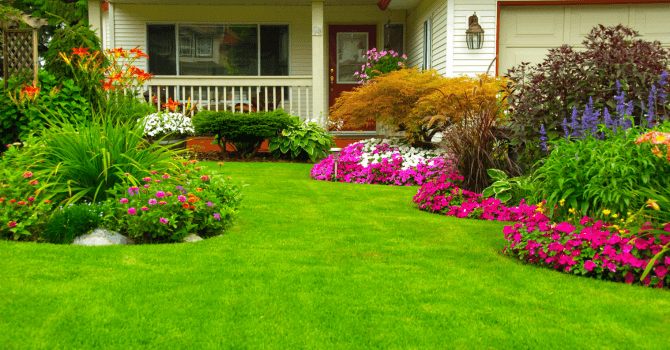
Source: Canva
Know your site
First things first, it’s important to know and understand the site you’re working on to begin planning the pieces for a garden. Start by getting familiar with the site or plot of land where your garden will live. This includes details such as the following:
the amount of light present throughout the day ;
the amount of shade ;
the moisture conditions of your lawn and surrounding area ;
the typography, the forms and features on the surface of your land.
These are key elements when it comes to determining the flowers that will be best for your land. Soil is another crucial factor when it comes to the choice of flowers. To plant a successful garden, we’d recommend doing a soil test. This will allow you to figure out what plants grow best in your soil. To do this, dig a 1-foot deep hole and gather some soil. Repeat this process in several places around your garden until you’ve filled a jar. Then, your soil can be sent to a testing lab and these results will let you know which plants will grow best in your soil.
Know your flowers
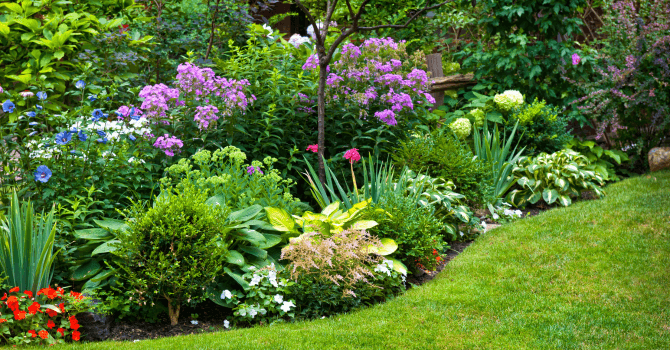
Source: Canva
If you go through with the soil test, it’s likely you’re now aware of what kind of flowers work best for your site. Learning what plants grow well in your soil is an important step before laying out a design. If you decided against the soil test, we’d recommend visiting parks or nature spaces in your area. Take a look at some of the native flowers growing and make note of them. This will offer you some insight into plants that will do well in your garden. Of course, light and weather conditions are other factors that must be considered for your personal plot of land.
Another note is to be aware of your frost cycle, which will greatly affect which flowers you can grow and how to tend to them. Knowing the first and last frost dates of your area will help your flowers to survive through their first season. This is because it will affect when you start seeding and allow for your plants to grow into the autumn months. It’s recommended to start your seeds 4-6 weeks before the last frost date. Seeds should be started in a greenhouse and if you don’t have access to one, a covered tray outdoors.
Choosing your palette
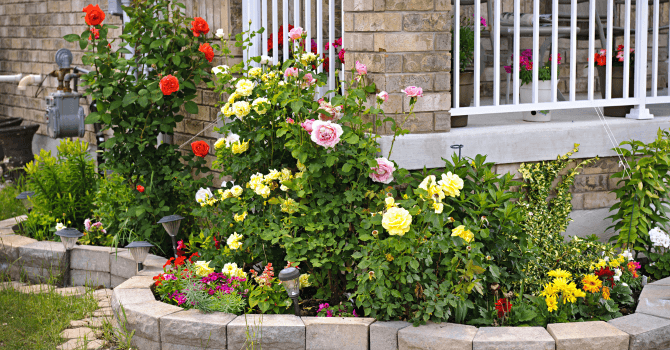
Source: Canva
Here’s where your creative side gets to flourish. Once you know the flowers that will grow best in your region, you can begin to choose colours and shades that will compliment your landscape as well as your home’s exterior. One note is to choose variations and different tones of the same colour to help unify your garden.
Of course, you could be more interested in contrast and pops of colours. There are many ways to create balance and harmony while also crafting a garden that’s full of variety and visually interesting.
Do remember not to make things feel too overwhelming and create little moments of peace amongst the pops of colours. Leave negative space between colourful flower beds or add neutral flowers between vibrant ones. Our eyes need some time to rest and process from all the high drama of spectacular flower displays.
Layout and design
For our final steps, we need to discuss how to approach the layout and design of a flower garden. We’d suggest starting by examining the shapes of the various flowers you’ve chosen to include and putting different complementary shapes together. Planting similar shapes side by side can add to overall harmony. Repetition is another way to approach the design process. If you strategically place the same flowers in certain areas around your garden, it can offer a nice visual continuity.
Layer your flower combinations from back to front, making sure to consider how each layer flows with the one directly above it. Of course, as flowers grow, they move. Thus, it’s important to think about how the movement of flowers to and away from one another will affect your layout and design. It’s worth mentioning that there is no correct way to arrange a flower garden and it comes down to personal taste, creativity and style. So, with that in mind, be bold and thoughtful in the ways that work for you when designing your garden.
Do you want to have an estimation of the cost of your next landscaping project? Read our article Landscaping: the Cost of the Various Projects for 2021.
Get 3 renovation quotes for your landscaping project
RenoQuotes.com can help you get quotes for your landscaping project. If you submit your project to us, we’ll put you in contact with top-rated contractors. Fill in the form on the homepage (it only takes a few minutes), and you will receive quotes from companies that are specialized in home renovations.
Dial 1-844 828-1588 to speak with one of our customer service representatives
Looking for something else?
Related articles
The latest industry news, interviews, technologies, and resources.

Editorial Team
•08 Nov 2023
We’d all love for our interior and exterior walls to stay bright and fresh as if newly painted. Of course, paint doesn’t last forever and will often give in to the effects of time as well as the wears of everyday life. Have you noticed your paint starting to have a discoloured appearance? If you run your hands over your walls and find a white, chalky substance, this means that you’re dealing with something referred to as paint chalking.
Équipe éditoriale
•08 Nov 2023
It’s difficult to deny that as soon as the chilly weather arrives, rushing to the thermostat to crank up the heat seems like the only way to keep the inside of the home warm and comfortable. What you may not realize is that even if your heaters are on full blast, the indoor temperature will only stay cosy if your home is insulated correctly.
Editorial Team
•27 Jan 2026
A kitchen remodel is one of the most common renovation endeavours, especially in terms of flooring. Kitchen floors have to put up with a great deal of daily use, resulting in fast-tracked wear and tear. This area goes through it, from falling pots and pans, boiling liquid or other spills to normal foot traffic.
Editorial Team
•05 Dec 2023
Storage space for some, unfinished room for others, yet thanks to its size the basement is a part of the house brimming with possibilities. Whether you’re ready to invest or get inventive, there is no limit to your comfort. Make your basement transformation a reality without having to quash your creativity.
Editorial Team
•08 Nov 2023
Albeit the bathroom is almost always the smallest room in a home, it isn’t any less important. With a bit of creativity and strategically devised tips, a small bathroom can be both functional and aesthetic. In this article, we’ll delve into the five decoration tips that can help you use the space in your small bathroom to your advantage without compromising comfort or design. These tips can help you design a practical and elegant bathroom. So, get ready to transform your small bathroom into a genuine interior décor masterpiece!