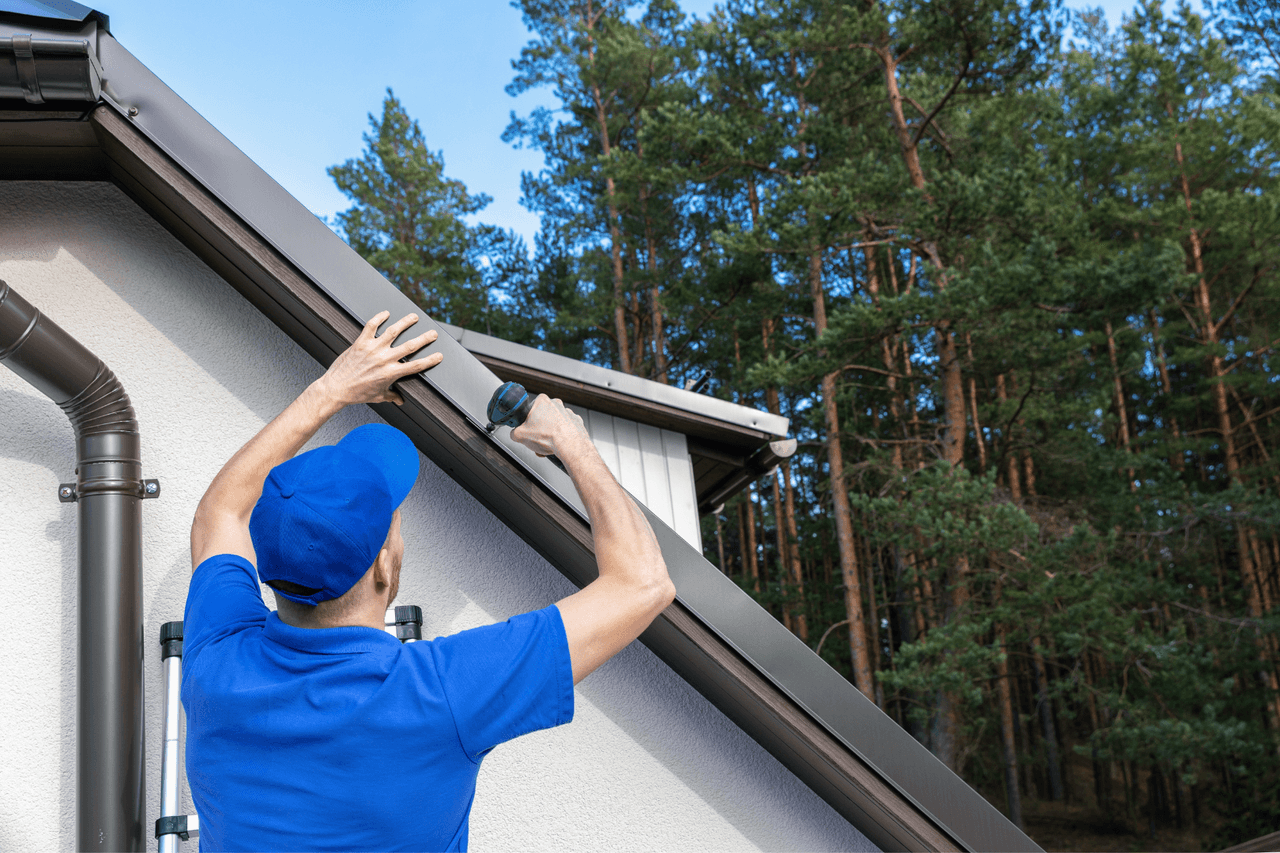
A drip edge costs $2 to $4 per linear foot installed during a roof replacement, or $6 to $12 per linear foot to retrofit onto an existing roof. For a typical home with about 200 linear feet of roof perimeter, that's $400 to $800 as part of a new roof, or $1,200 to $2,400 added later.
Most homeowners recognize fascias, soffits, and flashings. Drip edge is the component nobody talks about, and it's the one that determines whether water ends up in your gutter or behind your fascia. This guide covers what it does, which type and material to choose, what installation involves, and what it costs.
What a Drip Edge Does
Source: Canva
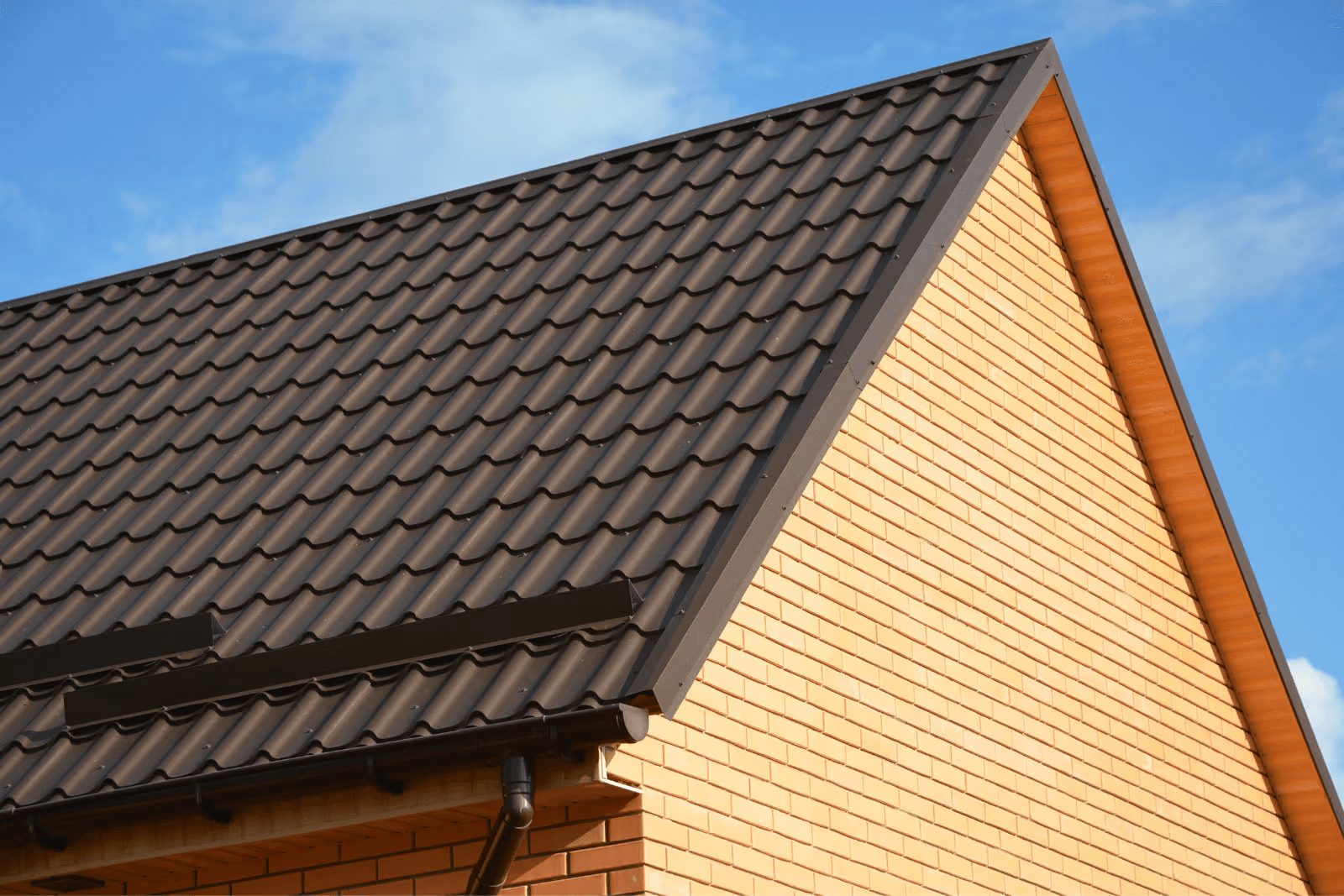
A drip edge is a metal flashing, usually L-shaped, installed along the edges of a roof. Also called drip edge flashing or D-metal, it keeps water away from the edge of the eaves and channels it into the gutter.
Without it, roof water flows between the fascia and gutter and backs up under the shingles.
Why It Matters
Moisture protection: It directs water into the gutter rather than behind it, which protects the fascia, the roof deck, and the soffit cavity from rot.
Wind-driven rain: In a storm, wind pushes water across the roof in every direction. The drip edge catches it and forces it to follow the roof's slope rather than spreading sideways under the shingles.
Ice dam resistance: When ice dams form at the eaves, meltwater backs up under the shingles. A drip edge gives that water a path out rather than into the roof deck.
Pest deterrence: It seals the gap between the roof deck and the fascia, which is a common entry point for insects, bats, and small rodents.
Structural integrity: Protecting the roof deck edge from repeated wetting prevents the deterioration that eventually requires deck replacement.
The geometry is what makes it work. The top flange extends 2 to 4 inches onto the roof deck, where shingles cover it. The lower lip drops ½ to 1½ inches below the sheathing edge, held ¼ to ½ inch off the fascia so water drips free rather than running down the board.
Is a drip edge mandatory?
Most building codes across North America require drip edge on shingle roofs, and the Asphalt Roofing Manufacturers Association recommends it on every installation.
Many older Canadian homes don't have one, because the requirement is relatively recent and enforcement under the National Building Code has historically varied by province and municipality. Shingle manufacturers increasingly require drip edge for warranty coverage, which matters more than the code question for most homeowners.
Check your local building code before a roof replacement. If your roofer's quote doesn't mention drip edge, ask why.
Drip Edge Profile Types
Three profiles cover nearly every residential application.
Type | Shape | Best for |
Type C | L-shaped, bent at 90 degrees | The classic profile, suitable for most standard roofs |
Type D | T-shaped, projects further from the edge | Homes where fascia protection is the priority |
Type F | Extended leading edge, known as a gutter apron | Installing over existing shingles |
Type C
The classic L style, bent at a 90-degree angle. It's the most economical option and works well on standard roof configurations.
Type D
The T style, also called D-metal, with a profile that projects further from the roof edge than Type C. It's preferred for its capacity to keep water away from the fascia, which makes it the better choice on homes where fascia damage has been a problem.
Type F
Distinguished by its longer extended leading edge, which makes it the sensible choice when installing over existing shingles. It's widely called a gutter apron in the trade, and it's what most roofers reach for when adding drip edge to a roof that already has shingles.
It costs slightly more than Type C and D.
J-Channel
A fourth profile exists, shaped like a J, but it's uncommon on roofs. J-channel drip edges are designed for windows and doors rather than roofing, which is a distinction worth knowing if you're shopping by shape rather than by name.
Eaves vs. Rake Edges
Drip edge installs along both the eaves, meaning the horizontal lower edge, and the rake edges, meaning the sloped sides of a gable.
The two aren't installed the same way. Eave drip edge goes under the underlayment. Rake drip edge goes over it. Getting this backwards is a common installation error and it causes water to run behind the flashing rather than over it.
Drip Edge Materials
Material | Material cost per linear foot | Durability | Best for |
Aluminum | $0.75 to $1.50 | Good | The default residential choice |
Galvanized steel | $0.75 to $1.75 | Very good | High-wind areas, maximum rigidity |
Copper | $4 to $12 | Excellent | Heritage homes, premium projects |
Vinyl or plastic | $0.50 to $1.25 | Fair | Doors and windows, not roofs |
Fibreglass | $1 to $2 | Fair | Specialty applications |
Aluminum
The most widely used material for residential drip edge in Canada. It's lightweight, corrosion-resistant, available in a range of colours to match trim, and the cheapest of the metals.
Its weakness is rigidity. Aluminum is less resistant to physical damage than galvanized steel, though it won't rust.
Galvanized Steel
Heavier and more rigid than aluminum, which makes it the better choice in high-wind regions where the drip edge profile is exposed.
Standard residential galvanized drip edge runs 26 to 28 gauge, which is what you'll find off the shelf. Heavier 24-gauge material is available and genuinely more rigid, though it's commercial-grade stock that's harder to cut and bend cleanly on site.
Copper
The premium option, used on heritage properties and high-end projects where appearance matters. It develops a patina over time and lasts essentially indefinitely.
Specify at least 0.69 mm thickness, equivalent to 20-ounce copper, for it to perform properly.
Expect copper to add $600 to $1,500 to a typical home compared to aluminum.
Non-Metallic Options
Drip edge is also manufactured in plastic, vinyl, and fibreglass. Use these for doors and windows, not for roofing.
Metal is the right answer on a roof because of its durability and resistance to the thermal cycling, UV exposure, and ice loading a roof edge experiences.
Vented Drip Edge
A variation worth knowing about on homes with inadequate soffit ventilation. Vented drip edge incorporates openings that allow air into the attic at the eave, supplementing or replacing soffit vents.
It's useful on homes with narrow soffits or where existing soffit vents are blocked by insulation. It costs roughly 50% more than standard drip edge and should be specified alongside a proper attic ventilation assessment rather than on its own.
Choosing the Right Drip Edge
Four decisions, in order of importance.
Check your local building code first: Requirements vary by municipality, and some specify minimum dimensions or materials.
Match the material to your climate: Aluminum suits most of Canada, galvanized steel is better in high-wind regions, and copper is a heritage or premium choice.
Choose the profile for your situation: Type C for a standard new roof, Type D where fascia protection is the priority, and Type F over existing shingles.
Confirm the dimensions: The top flange should extend 2 to 4 inches onto the deck, and thicker material performs better under ice load.
Corrosion-resistant metals matter most near salt water or heavily salted roads. Aluminum and galvanized steel both resist corrosion, but aluminum holds up better in coastal environments.
What a Drip Edge Costs
Source: Canva
Installed Cost
Installation type | Cost per linear foot | Typical total, 200 linear ft |
During a roof replacement | $2 to $4 | $400 to $800 |
On an existing roof (retrofit) | $6 to $12 | $1,200 to $2,400 |
Retrofitting costs roughly three times as much as installing during a replacement. The reason is labour: adding drip edge to an existing roof means lifting and refastening shingles along the entire perimeter, which is slow, careful work.
Labour alone runs $1 to $2 per linear foot during a roof replacement, when the crew is already working along the edge.
Measuring Your Roof
Drip edge is priced by linear foot of roof perimeter, counting both eaves and rake edges.
A typical 2,000 square foot home has roughly 200 linear feet of eave and rake perimeter combined. A bungalow with a simple roofline has less; a two-storey with multiple gables and dormers has considerably more.
Related Costs
Drip edge is rarely replaced in isolation, since the conditions that damage it tend to damage its neighbours.
Related work | Cost |
Fascia and soffit replacement | $9 to $34 per linear foot |
$12 to $25 per linear foot | |
Roof deck repair at the edge | $4 to $10 per square foot |
The Practical Case
Drip edge is the cheapest insurance on a roof. At $400 to $800 during a replacement, it's a rounding error against the cost of the roof itself.
The alternative is instructive. A home without drip edge that develops fascia rot typically faces $2,000 to $4,000 in fascia replacement, plus the cost of properly installing the drip edge that should have been there from the start.
Insist on it during a roof replacement. It should be included in the per-square price, and a quote that excludes it is incomplete rather than cheap.
Drip Edge Installation
Installation is straightforward in principle and dependent on sequence in practice.
How It's Installed
Install eave drip edge first, fastened directly to the roof deck before the underlayment goes down.
Lay the underlayment over the eave drip edge so water running on the underlayment drains onto the flashing.
Install rake drip edge over the underlayment, working from the bottom up so each piece overlaps the one below.
Overlap each section by at least 2 inches, with the upper piece on top.
Fasten with roofing nails at no more than 12 inches on centre along the top flange, never through the face.
Miter or fold at corners and peaks so water can't enter at the joint.
Seal critical joints with roofing cement where the geometry makes a clean overlap impossible.
Install shingles, which cover the top flange and hold the drip edge in place.
Common Installation Errors
Reversing the underlayment sequence: Eave drip edge under, rake drip edge over. Getting this backwards sends water behind the flashing.
Insufficient overlap: Less than 2 inches at the joints lets water track backward.
Nailing through the face: Fasteners belong in the top flange where shingles will cover them.
Lower lip too close to the fascia: It needs a ¼ to ½ inch gap to let water drip free rather than tracking down the fascia board.
Skipping corners: Unmitered corners are the most common leak point on an otherwise correct installation.
A furring strip is sometimes added behind the drip edge on older homes where the fascia isn't plumb, which restores the proper gap.
Replacing a Damaged Drip Edge
Source: Canva
When It Needs Replacing
Visible rust, corrosion, or holes, particularly on older galvanized steel.
Bent, loose, or separated sections, often from ladder damage or ice.
Water staining on the fascia below, which indicates water is bypassing the flashing.
Roof deck deterioration at the edge, visible from the attic or from below.
Missing drip edge entirely, which is common on pre-1990 Canadian homes.
What Replacement Involves
On an existing roof, replacement means lifting the shingles along the affected edge, removing the old flashing, installing new, and refastening the shingles.
Tools involved are a flat pry bar and tin snips, plus roofing nails and cement. It's within reach for a confident DIYer on a single-storey roof, though the work is slow and every shingle disturbed is a shingle that can crack.
The sensible approach is to replace it during a roof replacement. At $2 to $4 per linear foot alongside a new roof, against $6 to $12 as a standalone job, waiting usually makes financial sense unless there's active water damage.
When to call a contractor
Two-storey or steep roofs: The fall risk outweighs the saving.
Existing roof deck deterioration: This needs assessing before anything else happens.
Shingles near the end of their life: Brittle shingles crack when lifted.
Any sign of water entry: The drip edge may be a symptom rather than the cause.
A roofing contractor will typically assess the fascia, soffit, and gutter at the same time, since the four work together.
Frequently Asked Questions
What is a drip edge?
A metal flashing, usually L-shaped, installed along the edges of a roof. It directs water away from the fascia and into the gutter, preventing it from backing up under the shingles or running behind the gutter.
How much does a drip edge cost?
$2 to $4 per linear foot installed during a roof replacement, or $6 to $12 per linear foot as a retrofit on an existing roof. For a typical home with 200 linear feet of perimeter, that's $400 to $800 or $1,200 to $2,400 respectively.
Is a drip edge required by code?
Most North American building codes require it on shingle roofs, and the Asphalt Roofing Manufacturers Association recommends it universally. Many shingle manufacturers also require it for warranty coverage. Enforcement under the National Building Code has varied by province and municipality, so confirm locally.
What type of drip edge should I use?
Type C for a standard new roof, Type D where keeping water off the fascia is the priority, and Type F, known as a gutter apron, when installing over existing shingles. J-channel is for windows and doors rather than roofs.
What material is best for drip edge?
Aluminum for most Canadian homes, given its corrosion resistance and low cost. Galvanized steel in 26 to 28 gauge for high-wind areas where rigidity matters. Copper at 0.69 mm or 20 ounces for heritage and premium projects.
Does drip edge go over or under the underlayment?
Both, depending on location. Eave drip edge goes under the underlayment, and rake drip edge goes over it. Reversing this is a common error that sends water behind the flashing.
Can I install drip edge myself?
On a single-storey roof during a reroof, yes, with a flat pry bar, tin snips, and roofing nails. Retrofitting onto an existing roof means lifting shingles along the whole perimeter, which risks cracking them. Two-storey and steep roofs should go to a contractor.
How long does drip edge last?
Aluminum and galvanized steel typically last as long as the roof itself, 20 to 30 years. Copper lasts considerably longer. Replacement is usually driven by physical damage or roof replacement rather than by the material wearing out.
Can drip edge be added to an existing roof?
Yes, but it costs roughly three times as much as installing it during a replacement, because shingles along the entire perimeter have to be lifted and refastened. Unless there's active water damage, waiting for the next roof replacement usually makes financial sense.
What is vented drip edge?
A variation with built-in openings that allow air into the attic at the eave, supplementing or replacing soffit vents. It's useful on homes with narrow soffits or blocked soffit vents, and costs roughly 50% more than standard drip edge.
Does drip edge prevent ice dams?
It doesn't prevent them, but it limits the damage they cause. When an ice dam forms and meltwater backs up under the shingles, the drip edge gives that water a path out rather than into the roof deck. Preventing ice dams requires attic insulation and ventilation.
How far should the drip edge extend?
The top flange extends 2 to 4 inches onto the roof deck, where shingles cover it. The lower lip drops ½ to 1½ inches below the sheathing edge and sits ¼ to ½ inch away from the fascia. Too tight against the fascia and water runs down the board instead of dripping free into the gutter.
Looking for something else?
Related articles
The latest industry news, interviews, technologies, and resources.
Editorial Team
•08 Nov 2023
A cottage is a luxury, and thus, owning one is something that should be taken seriously. Though it’s usually best to wait for the warmer months to take on your cottage renovation project, spring and summer are just around the corner! Everyone chooses to renovate their cottages for different reasons, whether that be cosmetic or structural.
Amanda Harvey
•03 Aug 2026
Painting the outside of a house can be a long and gruelling process, but if completed correctly, the transformation can be dramatic! When high-quality exterior paint is applied to a properly treated surface, it’ll last much longer than expected. As well, it will protect the outside of your home from sun, wind, rain and snow. Although the price of paint will often indicate quality, there are several other factors that will help you to determine which paint is right for the exterior of your home.

Editorial Team
•19 Mar 2026
Across Canada, we long for warm weather. Balmy months mean a chance to enjoy the great outdoors, and if you’re lucky, that also means enjoying a glass of wine on the comfort of your balcony. If your home has a balcony, you already know that keeping it in shape takes a little bit of effort and elbow grease.
Cynthia Pigeon
•08 Nov 2023
When a kitchen is too small to meet a household's needs, it quickly becomes a nuisance. And, since most people spend several hours a day in their kitchen, the lack of space is definitely felt on a daily basis. Therefore, a bigger kitchen is a recurring item on many homeowners' wish lists.
Christine Simard
•19 Apr 2024
When living in the city, the option of having an outdoor courtyard at home is often minimal, even more so if you are a tenant. However, if you are lucky to own a home in the city and it comes with a backyard, the dimensions available to you may be restrictive.