Working in Renovation: Professional Painting
By Editorial Team
Updated on August 28, 2024

Pursuing a career in professional house painting isn’t as simple as picking up a paintbrush and hoping for the best. In fact, this is an excellent trade for all to pursue, especially if you have a knack for paying attention to detail as well as expert level patience. However, becoming a professional painter requires much more than simply making the surfaces of a home look attractive. So, if you’re interested in this trade or you’re already working in the realm of home renovation, how can you move towards a career in professional painting?
Before you can move forward working as a professional painter, you need to know what’s involved as well as what it means to invest in this career. Luckily, we’re going to offer a rundown of what it’s like to work as a professional painter.
Working in renovation: professional painter
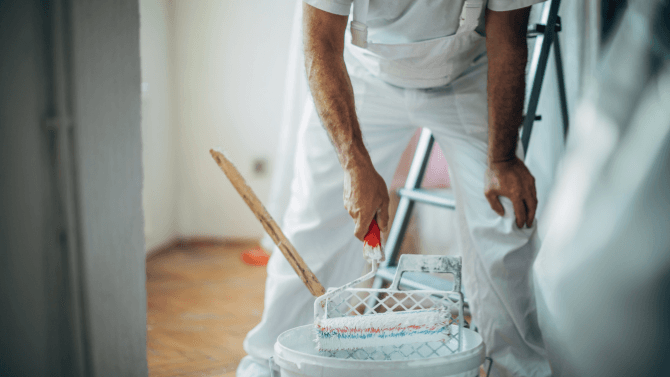
Source : Canva
What do painting contractors do?
As you may have guessed, a painter's primary job is to do just that: paint. In a nutshell, this profession's main focus is to prepare surfaces as well as apply coating for both aesthetic and protective purposes. Of course, the work of a painter will generally stretch beyond simply coating the walls. In fact, a painter will need the skills to remove fixtures and replace them following the job, as well as knowing the right methods to cover and protect furniture, floors and other elements of a room.
The surfaces that professional painters cover are varied. Material wise, they can range from wood, drywall, concrete, and steel. These surfaces can live in commercial buildings such as factories, offices, storefronts, and institutions as well as in homes or apartments. When it comes to exterior painting, this job is usually done to protect or maintain these outdoor surfaces.
Other skills that most professional painters will need include an understanding of wallcovering installation, decorative as well as faux finishes. Furthermore, some painters may take up learning plaster, drywall and insulation techniques to further diversify their skills.
How to break into the world of professional painting?
The way that you break into the world of professional painting will have a lot to do with your personal trajectory. For many, there are no formal educational standards for painter contractors. Painters come up in many different fashions but most begin by way of apprenticeships for companies or directly under more experienced painters. To gain the relevant skills necessary to call yourself a professional painter, you should expect to spend two to four years in training. This will not only include painting experience but should also involve blueprint reading, measurement techniques as well as the use of basic painting tools.
Depending on the city or municipality where you’re living, the requirements for working as a painter will vary. In some instances, it will be necessary to complete technical school, specific classes or programs sponsored by trade unions in order to be fully certified. This may include a course that will inform new contractors about the risks and proper safety procedures for working with hazardous materials, including lead-based paints.
Do plenty of research to obtain the licensing requirements for the area in which you’re planning on working. In most cases, this will involve applying for a basic contractor's license, a certification exam and a number of hours that prove you have the viable experience to take on this profession.
Looking for something else?
Related articles
The latest industry news, interviews, technologies, and resources.

Cynthia Pigeon
•18 Jun 2026
Planning renovation or construction work in Quebec means making strategic decisions long before the first hammer is swung. Given the realities of our Quebec climate—freezing winters, major spring freeze-thaw cycles, and high summer humidity—the strength, compliance, and durability of a building depend on informed decisions.

Editorial Team
•08 Oct 2025
When it comes to choosing a career path, we’re often faced with multiple options that can lead to confusion and render the task at hand much more difficult. The best way to proceed in such a situation is to opt for a profession that’s in line with our interests and one that has positive prospects.
Cynthia Pigeon
•31 Jul 2026
Whether you are an owner-occupant, investor, or senior preparing your home for the future, Quebec’s economic conditions and climate requirements demand rigorous budget management. With harsh winters, repeated freeze-thaw cycles, and continually rising energy costs, residential renovations represent a strategic decision.

Editorial Team
•28 Jan 2025
2025 is gearing up to introduce significant changes to Quebec’s construction industry. A lot is happening, from the discontinuation of certain grants or subsidies to the revision of technical regulations, with the emergence of initiatives promoting social inclusion to redefine industry practices in between. How are these changes influencing your projects and your competitive edge? What strategies can you adopt to shape your practices around this new normal? This guide highlights the key changes to anticipate to thrive in this fast-changing environment.

Editorial Team
•08 Nov 2023
Regardless of the size of your home renovation project, it likely isn’t an easy undertaking. A lot of planning, time and energy go into a renovation and for this reason, you’re probably looking for a way to make things just a little bit easier.