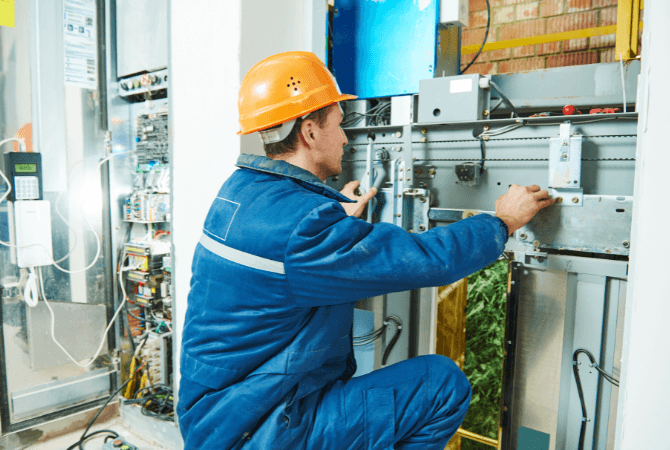
Are you particularly handy, meticulous, and love working with machinery? You’re not afraid of heights, consider yourself a problem solver, and can manage your stress levels…how about considering specializing in elevator installation, repair, and maintenance! This type of work, with diverse duties, has excellent employment prospects; just consider the number of apartment and condo towers that are being built every month in urban and suburban areas.
An Elevator Mechanic’s Duties

Source: Tima Miroshnichenko – Pexels
The key role of such a tradesperson consists of ensuring the proper functioning of mechanical and electric motion systems that are found in elevators, freight elevators, dumbwaiters, and escalators. As such, depending on the chosen industry, the individual in question will be able to install, repair, modernize, or maintain these systems used to transport materials or individuals.
All-around handy, this type of mechanic must know the ins and outs of electricity, electronics, welding, hydraulics, mechanics, and so forth.
On top of the above-mentioned elements, the academic training and on-site experience will teach future elevator mechanics to accomplish the following:
Interpret blueprints, sketches, and quotes directly linked to the system's components
Use various techniques and tools
Prepare construction work (piping, wiring, framework, etc.)
Respect standards to ensure the safe use of devices, worksite, and public (before, during, and after the work is completed)
Assemble cabins, install control units, and the necessary wiring for electrical or electronic controls
Perform general preventative maintenance
Test material to spot weaknesses
Disassemble, repair, or replace defectives units
Carry out final performance assessments of devices to ensure safe use and compliance
Provide quotes to prospective clients
Required Skillset to Become a Good Elevator Mechanic
Since this trade requires one to be working, suspended at great heights or wedged in tight spaces, one can’t be acrophobic or claustrophobic.
Being dexterous and having excellent hand-eye coordination to handle moving parts are essential to practice the trade.
Since the job requires one to play around with high-voltage electromotive forces or handle tiny parts, the mechanic must be meticulous, precise, and have a heightened sense of responsibility.
Being naturally gifted with mathematics and calculations, in general, is just as important as developing one’s observational and analytical skills to solve complex problems.
Often working alone during maintenance calls, one must have a healthy dose of know-how and autonomy in their DNA to work as an elevator mechanic. On the flip side, the mechanic must be able to easily work with other players in the business (installers, electricians, contractors, homeowners, etc.).
Some employers will request for their workforce to be bilingual and have the capacity to work everywhere in Quebec (must hold a valid driver’s license and have access to a vehicle). As such, offering 24/7, on-call services during peak periods will be considered an asset during the hiring process.
How to Become an Elevator Mechanic or Installer
Source: Kelly – Pexels
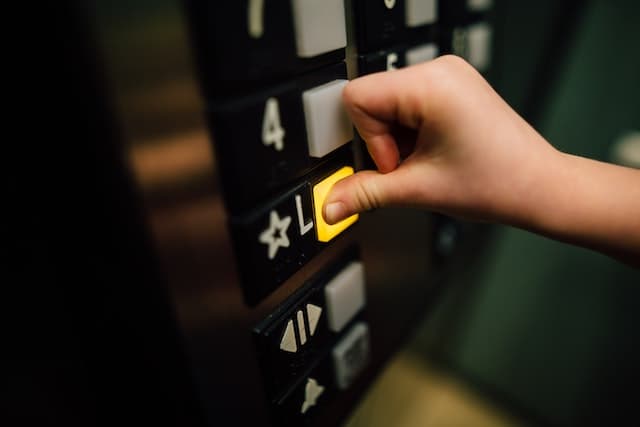
To work in any trades related to the installation or repair of various elevator systems, one must complete a DVS in Elevator Mechanics—Maintenance Mechanics—full-time for a period of two years, meaning 1,800 hours. This training program is only offered in one educational establishment in Quebec, and that’s the École des métiers du Sud-Ouest-de-Montréal—the ÉMSOM (French), and the training can be completed in English.
Note that you won’t need to go through an internship during the course of your studies, since the learning period will be done on-site, as an apprentice. To do so, you’ll first have to prove to the CCQ that you’ve successfully completed the training program. You’ll be asked to adhere to a syndicate, and then provide a guarantee from your employer giving you permission to work for them, and that, for a period of at least 150 hours over a three-month period. You’ll also have to obtain a workplace health and safety certification and provide a ($100) payment to the CCQ.
In case you want to work in the construction industry (industrial, commercial, institutional), you’ll then actually go through the steps to become a journeyperson.
Check out this website to know more about working in the construction industry without a diploma. (French)
Job Prospects and Trades Related to a DVS in Elevator Mechanics
The job prospects for diploma holders are excellent; demand is strong and there's a lack of qualified candidates. Keep in mind that training won’t only allow you to repair elevators, but also dumbwaiters, escalators, overhead cranes, and much more.
The construction industry can be seen as constantly seeking new hires, but you can also seek employment elsewhere. For example, manufacturers, certain private companies or specialized companies, or even real estate firms for that matter, offer their installation, repair, and maintenance services for individuals, businesses and public institutions.
In Quebec, the median wage is $39 an hour. The latter varies depending on the years of experience and the employment sector. The advantage of the trade is that it allows you to find year-round contracts, no matter the season.
In case this article convinced you or validated your career choice, here's a list of jobs waiting for your skillset:
Elevator mechanic
Escalator installer
Stair and overhead crane installer-repairer
Technical representative of elevators and other equipment
Looking for something else?
Related articles
The latest industry news, interviews, technologies, and resources.
Editorial Team
•08 Oct 2025
Being a pipefitter is an extremely technical trade that requires specific skills and training. Learn all about it to find out whether or not it’s the right trade for you.

Editorial Team
•18 Feb 2025
In the province of Quebec, the construction industry is particularly monitored and regulated. Hence why we’re making a point of raising awareness among residential homeowners regarding the importance of dealing with contractors holding the right RBQ licence.
Editorial Team
•23 Jul 2026
Even when winter is mild, does your heating bill keep climbing? Once you have made sure that all potential air leaks are properly sealed, it may be time to reassess your home’s insulation.
Editorial Team
•06 Jul 2025
Every self-build project inevitably begins with the following question: how much will it cost? It’s nearly impossible to set aside this important consideration.
Cynthia Pigeon
•07 May 2026
Building a pool house in Canada usually requires a building permit and strict compliance with local setback rules. These setbacks vary by municipality, but they often determine how close your structure can be to property lines, fences, neighbouring buildings and easements. Any electrical or plumbing work should be completed by qualified, licensed trades in accordance with provincial regulations. Your pool house must also respect local pool safety requirements to ensure it does not create unsafe or unsupervised access to the swimming area.