Resilient Flooring Layer: A Little-Known Trade
By Editorial Team
Updated on June 3, 2024

If you’re looking for a career in the construction industry where teamwork is essential and perfectionism is—at long last—valued, consider becoming a resilient interior flooring layer. This little-known profession, although essential, is seeing a significant labour shortage as a result of a large number of workers retiring.
Has it piqued your interest? Check out the following to find out whether your worker profile corresponds to that of the trade.
What does a resilient flooring layer do?
Source: Canva
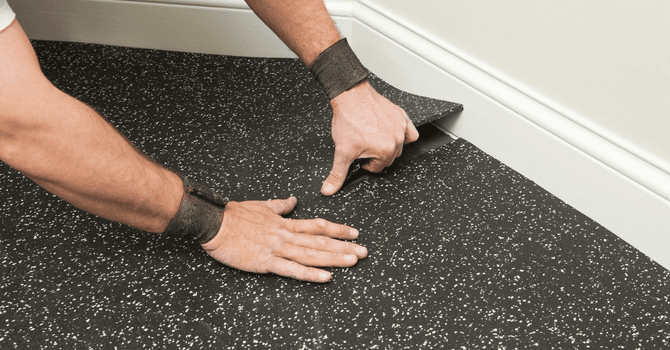
So, what’s resilient flooring, anyway? Well, it’s basically flooring that is resistant to impact, like carpet, underlayment, vinyl, linoleum, cork, rubber, and the list goes on.
Specially practical in commercial buildings or health centres, such materials require that the person performing the installation partake in a special academic training during which they’ll learn to:
Read and sketch plans and evaluate potential production costs;
Plan the work and prepare surfaces to be covered;
Ensure the worksite adheres to health and security measures;
Measure, cut, and alter flooring;
Adequately use various types of glue, polishers, vacuums, cement mixers, air hammers, and other tools;
Lay, replace, and repair flooring in buildings.
Do you have what it takes to become a resilient flooring layer?

Source: Canva
The skills and knowledge required to dominate this trade, and to successfully carry out the required tasks are, no surprise, linked to physical fitness and manual labour. Since you’ll be called to handle heavy tools and lean down, it goes without saying that you’ll need physical strength, great flexibility and stability, and be somewhat dexterous. Also, you’ll need to be able to spot the little details and have good observational skills.
On the intellectual side, mathematical and deductive skills, along with a sharp mind, are required. In fact, the first steps undertaken on a work site are the blueprints, calculations, and know-how about the materials’ characteristics.
Since it’s a very teamwork-prone type of job, you have to be comfortable speaking openly, organizing tasks logically, and gathering the necessary information to relay the information clearly and concisely. At the same time, your capacity to take initiative and be autonomous will be key to a successful career path.
If you’ve already turned to a career counsellor, it’s likely that they’ve already asked you to take the Holland test (RIASEC) to determine your personality traits and areas of interest.
Note that the profile that’s most likely to suit that of a resilient flooring layer is Realist - Investigative - Conventional. Simply put, though you’ve probably already figured that out based on the above-mentioned information, meaning individuals who prefer concrete and physical work, problem solvers, and those who walk a straight line in terms of conduct.
Note that some employers will mandate workers to be bilingual and have the ability to work anywhere in Quebec (driver’s license and transportation).
Carpet and Other Resilient Flooring Installers: Required Training

Source: Canva
To be able to work in a job related to various resilient flooring installations, you’ll need to complete a DVS (also known as a DEP) in Resilient Flooring Installation—Buildings and Public Works—which is 900 hours, full time. This training program is available in English and in French, depending on the establishment in question.
In a nutshell, these are the options available to you:
Capitale-Nationale - CSS de la Capitale - ÉMOICQ
Laval - CSS de Laval - C.F.P. Le Chantier
Montérégie - CSS Marie-Victorin - C.F.P. Pierre-Dupuy
Montréal - CSS de Montréal - École des métiers de la construction de Montréal
What the future holds for a resilient flooring layer
You’ll have to show up at the CCQ with a diploma attesting to your completion of a DVS in resilient flooring installation and find an employer that’s registered with the CCQ and guarantees 150 hours of work. Once these conditions are met, you’ll then move on to being an apprentice. To then obtain your journeyperson certificate, you’ll need to have accrued at least 2,000 hours of experience.
Once your career has taken off, you’ll make an average wage of $29/h; most likely a bit more depending on the industry in which you work. Most of the work sites are at institutional and commercial levels.
As for employers, they’re often flooring resellers or manufacturers as well as construction contractors. Note that, if you have an entrepreneurial bone, this trade is perfect to eventually go out on your own.
Some relevant links:
Find a career in the renovation industry
RenoQuotes.com can guide you along your job search in the renovation industry. Tell us about your career prospects, and we'll help you get in touch with contractors who are likely to be interested in your skills, free of charge. Simply fill in our form (it'll only take a few minutes) and we'll take care of sending your candidate application to employers.
Dial 1-844 828-1588 to speak with one of our customer service representatives.
Looking for something else?
Related articles
The latest industry news, interviews, technologies, and resources.

Paul Riopel
•19 Jun 2026
Navigating the complexities of electrical licencing can be daunting. From understanding the requirements to completing the application process, aspiring electrical contractors often face various challenges. In this article, we aim to simplify the process and provide clear guidance on obtaining an Electrical Contractor's Licence in Ontario. Additionally, we shed light on the importance of licencing in ensuring safety and compliance with regulations enforced by the Electrical Safety Authority.

Editorial Team
•08 Nov 2023
RenoQuotes.com followed home renovation contractor Ali Nazar on the job at the site of a basement renovation project in Montreal. Check out this interview to know more about the subject of basement renovations.
Léa Plourde-Archer
•17 Feb 2025
Are you planning on renovating your kitchen? This process can be long and complicated, as it involves several steps as well as a number of factors that can affect the price, the duration of the work and the durability of the materials.

Léa Plourde-Archer
•06 Sep 2024
Are you preoccupied with the current state of your floors? Do they need to be maintained or completely replaced? We have gathered several articles published on our home renovation blog in order to classify them under different categories. Therefore, you will be able to identify articles that interest you, so that you can find the information you are looking for:

Editorial Team
•08 Nov 2023
If you haven’t heard of a wet room before, we recommend you start paying attention to this growing trend. The wet room is becoming more desirable as a minimalist, one-of-a-kind feature that works to add value to your home.