Self-Cleaning Glass: A Promising Product
By Amanda Harvey
Updated on August 13, 2025

The arrival of spring often brings its share of cleaning tasks, such as cleaning windows, for example. Both long and tedious, the process of cleaning window after window can be a moment of pure boredom that is hard to get through, even with good background music playing.
A glimmer of hope timidly appears in the form of a newly marketed technology: self-cleaning glass.
What is Self-Cleaning Glass?

Source: Canva
How Is Self-Cleaning Glass Made?
The manufacturing of self-cleaning glass begins with the creation of float glass. This is actually a flat glass on which a very thin protective layer (a layer of titanium dioxide) is applied. Its production mainly consists of floating the molten glass on the surface of a tin bath before being molded and cooled. A furnace designed to produce this type of glass can produce panes with thicknesses varying between 2 and 19 millimeters.
This technology, once reserved for certain large-scale buildings around the world (think of some office buildings in Brussels, Italy, or even the Louvre pyramid), is gradually becoming available commercially.
How Does Self-Cleaning Glass Work?
Self-cleaning glass operates in two ways. First, through activation by light, where the titanium dioxide layer changes the contact angle between the glass and water droplets. Titanium dioxide acts as a photocatalyst, meaning chemical reactions occur when ultraviolet or UV rays come into contact with the window. When UV light reaches the layer, electrons are generated. These electrons transform water molecules into hydroxyl radicals. These hydroxyl radicals attack dirt, breaking it down into small particles that are washed away by rain.
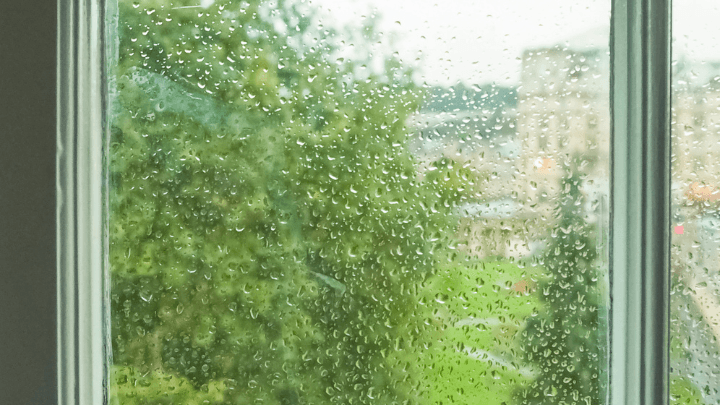
Secondly, self-cleaning glass is hydrophilic, while normal glass is hydrophobic. When it rains, hydrophilic glass causes water to spread out and form a uniform film instead of remaining as individual droplets. Thus, rainwater can clean the entire pane rather than leaving streaks and marks often seen on standard glass. Titanium dioxide and the hydrophilic properties work together to help self-cleaning windows maintain their clean appearance.
Advantages of Self-Cleaning Glass
Source: Canva
Self-cleaning glass features two main and distinct advantages over traditional glass:
First, it allows organic matter deposited on the glass to decompose under sunlight thanks to photocatalysis. But what happens on gray, cloudy days? Since most sunlight rays still manage to pass through clouds, the process’s effectiveness is not affected.
Second, it is hydrophilic. Whereas water usually runs off as droplets on the glass surface, self-cleaning glass causes water landing on it to turn into a film that then slides down. This prevents the dirt marks caused by drying droplets on the surface.
These two characteristics work closely together, which explains their effectiveness. When debris is broken down, all you need is to wait for a rainy day or spray the window so the water film slides down and carries away all debris. Likewise, self-cleaning windows dry faster than conventional windows.
Besides these advantages, self-cleaning glass technology is very helpful for reaching high windows or cleaning buildings with large amounts of glazing. Also, note that frost does not stick to self-cleaning glass surfaces, which is quite practical during the cold season.
Although an indirect advantage, the fact that the glass does not require detergent products is environmentally responsible and, at the same time, reduces the costs related to purchasing cleaning supplies.
Disadvantages of Self-Cleaning Glass
Like every coin has two sides, some disadvantages exist regarding this technology. The first disadvantage concerns the possible incompatibility of new windows with existing frames, which will unfortunately require replacing them and therefore additional expenses.
Secondly, it must be noted that the breakdown of organic compounds absolutely depends on sunlight to work. Therefore, glass panes not exposed to sunlight due to their location will not be able to eliminate debris on their surface.
Next, it should be highlighted that certain waste (such as bird droppings) will require extra help to be removed from the glass surface. In this case, soap will be necessary. However, be careful not to use detergent products containing fatty acids, as these could make the glass surface hydrophobic. It should also be mentioned that self-cleaning windows cannot remove mineral deposits. These can thus contribute to dirtying the window just like traditional glass. Therefore, the window will still require manual cleaning, although much less frequently.
How Much Do Self-Cleaning Glass/Windows Cost? What Is Their Price?
Purchasing self-cleaning glass will require an additional investment of about 10% compared to the price of standard glass.
FAQ
What is the lifespan of self-cleaning glass?
Self-cleaning glass typically lasts 10 to 15 years, depending on the quality of the coating and environmental conditions.
What are the best practices for maintaining self-cleaning glass?
Clean gently with water and a soft cloth when needed. Avoid harsh chemicals or abrasive cleaners to protect the coating.
Looking for something else?
Related articles
The latest industry news, interviews, technologies, and resources.

Karine Dutemple
•10 Sep 2026
Any amateur or professional landscaper will love shrubs, which have a remarkable number of advantages. Whether they are appreciated for their ability to enhance the façade of a house or for their ability to create an area away from prying eyes, they are always a sure bet.
Editorial Team
•08 Nov 2023
Concrete is one of the most common construction materials on the planet. Up until the end of the 1900s, it was bestowed with numerous qualities, but none were that of luminosity…
Editorial Team
•18 Sep 2026
Dishwasher installation costs $150 to $400 in Canada for a straight replacement, and $350 to $800 when new plumbing or electrical work is involved. Most homeowners swapping an old unit for a new one in the same spot pay between $200 and $350.
Editorial Team
•08 Nov 2023
Kitchen floors covered in ceramic tiles are a durable and low-maintenance option for any home. However durable, one slip of a hot pot could easily cause a crack in the tiles, leaving you with a partially broken floor. Luckily, this is an easy fix that can be done without destroying the entire floor.
Cynthia Pigeon
•08 Nov 2023
One can easily think that residential roofs only need to remain leak-proof to be immune to the elements and guarantee the best home protection.